

Similar Posts
Applying Music Theory To Basslines
This is a video intending to show how you can make use of some of the music theory I’ve covered in the Music Theory For Bass Guitar series in your own bass playing. Lesson Material
Seventh Chord Arpeggios For Bass – The Ultimate Guide!
This week we’re looking at arpeggios and chord construction. Specifically Seventh Chords. For a further deep dive into Chord Construction and Harmony, Click Here To Check Out The Chord Tone Essentials Course! When you start out learning chord tones, it’s common for teachers to limit exercises to a few common patterns such as the Major…
Music Theory For Bass Guitar – Bass Chords #2 – Minor Chords, Voice Leading & Alternative Chords
This lesson deals with more chords shapes for bass guitar with the minor triad pattern and some alternative voicings for helping stay in one position. The concept of voice leading is also discussed. Lesson Material
Simplifying Jazz Chords
This lesson shows how you can simplify those big jazz chords and break them down to the core seventh chords or triads. This can be really helpful in negotiating progressions while playing walking basslines or playing chords on bass when there are less notes available over 4 strings.
Jazz Standard Analysis Guide – Billie’s Bounce
This week we’re delving a little deeper into the Charlie Parker tune Billie’s Bounce. We’re going to breakdown the chord progression and look at applying the chord tones/arpeggios to bass guitar This is an essential part of learning a Jazz Standard and creating walking bass lines or solos. Billie’s Bounce Practice Tracks
Music Theory For Bass Guitar – Intervals Part 2
This is the 2nd lesson covering the most basic building blocks of music and music theory: Intervals. This part covers the other intervals: minor, augmented and diminished. It also covers the concept of enharmonic equivalency . . . .”The What?!” . . . Yup, that’s right…. Enharmonic equivalency. How exciting. Quick Note: If you haven’t…


Thanks again for your lesson Mark. You have done so much into my playing and knowledge of music. Looking forward to the next video. :)
Thanks Bernard. Love hearing that people appreciate what I’m doing
Awesome lesson mate ;-)
Cheers Tyrone
Only lesson I could learn the Dim and Aug on Bass as chords and “awakened” me how to used them! thanks a trillion!
Absolutely brilliant. Outstanding work. Thank you so much for all of your videos and PDF:s.
I am thinking about a couple of things after watching this one:
(1) The C#dim as a “passing” chord. Can it also be seen as a substitute for the VI chord, A minor, in a I-VI-II-V progression? If so, then you could add an A as the root (or as an extra, lower, voice). I have tried it, and it works. But then you have a A dominant 7 chord, with a major third. I have heard that the V chord, i.e. the “dominant” can be played around with: going from major to minor, and using something called a “tritone substitution”. But here, it seems this can also be done with the VI chord…
About that “tritone substitution”… If I understand it correctly, a tritone is a diminished fifth interval. So, instead of a G7, you could use an C#7. A G7 contains G – B – D – F while a C#7 contains C# – F – G# – B. So that would be some kind of “passing” or chromatic approach, too, I guess… But I don’t think I have grasped this concept yet…
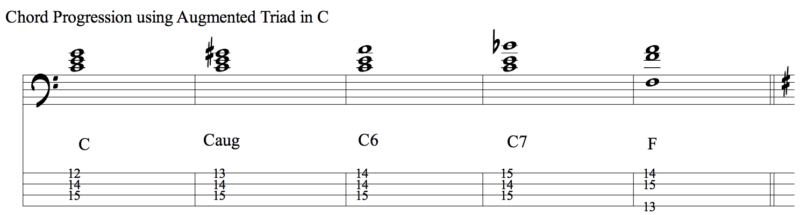
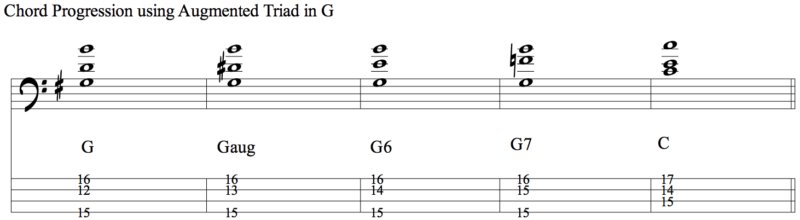
(2) The augmented chord, and others, in a melodic progression. Instead of
| C Caug C6 C7 F |
…could you write:
| Em/C E/C A/C Bdim/C F |
…or something similar? (I remember you saying in another video that such slash chords should be avoided, but still…)
Ha ha. Once again, you’ve stumbled upon a more advanced area of harmony. Good work!
The C#dim can be seen as a substitute for the Am7 in a roundabout kind of way. It’s easier to see it as voice leading and moving between the two chords a whole step apart but it is also related to Tritone Substitution.
Don’t be scared or confused by the name of the Tritone Substitution. It’s a very simple concept. Take a C7 chord: C E G Bb. It contains a tritone interval (a b5 as you pointed out). E to Bb. But we also have a hidden tritone interval of Bb to E because of the inversion and the fact that the Tritone is the only interval that is the same in inversion. So now we can make another dominant 7 chord using that Bb to E as our 3rd and b7. That gives us Gb7 (Ironically a Tritone away from our C7). So C7 and G7 are interchangeable as substitutes.
This works because the tritone interval is such a strong sound within the dominant 7 chord. The 3rd and the 7th are very important notes within the chord.
So now we can apply that concept. Look at a basic I – VI – II – V in C: Cmaj7 – Am7 – Dm7 – G7. There’s only one dominant 7 in the G7. So let’s tritone substitute it:
Cmaj7 – Am7 – Dm7 – Db7.
Notice how we get that chromatic descent of Dm7 – Db7 – Cmaj7. That’s what the Tritone is good for. This is great for using in improvisation because you can create chromatically descending lines.
But how does this relate to the original C#dim?
Well, we first have to look at something called a Secondary Dominant Chord. Any chord in a key can be transformed into a dominant 7 in order to give a greater pull to the next chord as if we are temporarily in a different key. This is also called Tonicisation. The following progressions all use Secondary Dominants:
Cmaj7 – A7 – Dm7 – G7
Cmaj7 – Am7 – D7 – G7
Cmaj7 – A7 – D7 – G7
If you try playing through any of these progressions you’ll hear how it adds that jazzy gameshow feel to them!
As I mentioned, these are all staying in the key of C. There is no modulation even though some people like to think there is.
So now we know we can create a whole bunch of dominant 7 chords as substitute chords within a key, you can apply the tritone substitution wherever you like:
Cmaj7 – Am7 – Ab7 – G7
Cmaj7 – Eb7 – Dm7 – Db7
Cmaj7 – Eb7 – Ab7 – Db7 (bit of a stretch with this one!)
To practice this, just try messing around with chord progressions and get used to the sound and feel of the tritone substitutions.
So now we can relate these to the Diminished Chords. There are two ways of looking at this.
1) The diminished chord has a tritone from the root: Cdim has C-Gb. So that can be used to relate our diminished chord to the dominant 7. Ab7 and D7 both have that tritone so now we can use them in place of the secondary dominants and tritone substitions. All we have to do is use a diminished chord built on the 3rd or 7th of a dominant 7 chord.
So in the key of C we can now play:
Cmaj7 – Am7 – Dm7 – Bdim
Cmaj7 – Am7 – Dm7 – Fdim
With the secondary dominants:
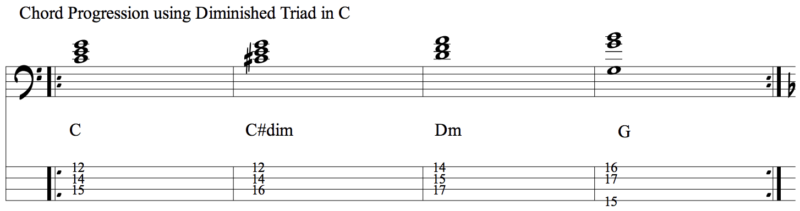
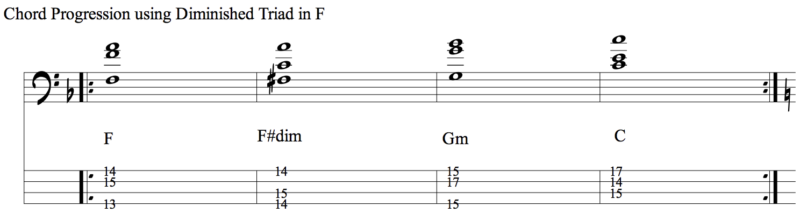
Cmaj7 – C#dim – Dm7 – G7
Cmaj7 – Gdim – Dm7 – G7
Cmaj7 – Am7 – F#dim – G7
Cmaj7 – Am7 – Cdim – G7
Cmaj7 – C#dim – F#dim – G7
Cmaj7 – Gdim – F#dim – G7
Cmaj7 – C#dim – Dm7 – B dim
etc. etc.
Don’t worry about applying to the Tritone Substitutions because it all works out the same in the end. You basically end up with a standard palette of substitutions based on Tritone relationships.
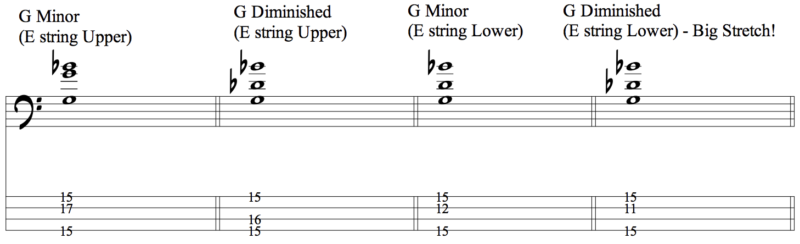
2) The other way of viewing the Diminished chord is via a basic extension of the Dominant Seventh chord. We can use a diminished chord to gives the impression of a 7b9 chord. So a G7 is G B D F. G7b9 is G B D F Ab. If we ignore the root note of G we have B D F Ab which is a Dimished 7 chord or B D F which is a Dim triad. So hey presto! We can substitute a Diminished chord starting on the 7th 3rd 5th or b9 of a Dominant 7 chord to give that 7b9 feel. This is often called Minorisation because we are giving the impression of being temporarily in a Minor key (Chord V of a minor key would have a b9).
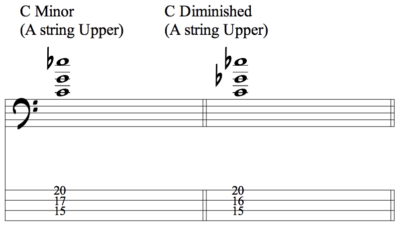
Either way, we end up with the same palette of diminished chords as before. If you want to take this even further, check out the other Dim chords that can be used. Any Diminished chord can be seen as symmetrical like the Augmented triad. This means C dim is the same as Ebdim and Gbdim. But we can add another chord to that small palette based on an extra minor 3rd of the Dim7. That gives us Cdim, Ebdim, Gbdim and Adim. So any dim chord can also be substituted with another dim at the b3, b5 and 6 or (more accurately) bb7. So we have can always choose from 4 dim chords and they will all have the same effect. At that point, root movement becomes the defining factor.
Phew!! That’s pretty much Jazz harmony in a nutshell. If you can get your head around Secondary Dominants, Tritone Substitutions and Diminished Harmony, most chord progressions will start to make a lot more sense.
Wow, that’s just…Awesome!!! You’ve just given me the most thorough and understandable explanation of these concepts ever. As an amateur, I’ve occasionally attended shorter jazz courses and have heard these terms thrown around. I’ve often gotten this vibe: “If you don’t already know what we’re talking about, you probably shouldn’t even ask and take up people’s time”. And when I do ask, no-one ever has the patience, or knowledge, or pedagogical skill, to actually enlighten me – things stay mysterious, and now I can’t even ask again, because I have already been told… :p
I actually understood e v e r y word of that wonderfully long answer! :) It feels great! Thanks soooooo much for your time and effort, Mark! Of course, I now need to apply this stuff to make it “stick” in my mind.
Oops. I guess it should be Db instead of C# since it’s a fifth.
Thank you so much Mark if i ever make it big with my band and someone ask me wow who taught to play like that I’ll just say Mark! You’re amazing
I just stumbled across this post. I coppied all the chords that were labled on this form from you Mark. Now I pasted them in a notepad file and now going to try them out. This will be fun. Just add some reverb to your bass and you are good to go.
I don’t have the largest hands so I struggle with some of the stretches with these chords eg flattening to make minor chords. Any advice or should I just use a short scale bass to make things easier?
Thank you so much Mark for all this lesson they are all new to me the finger positioning are a bit hard in the beggining but I ‘m starting to get muscles in my fingers, thanks again great job.