How To ACTUALLY Improvise Walking Bass With Just 2 Phrases
So, last time we built our very first walking foundation — roots and fifths, a two-feel, one or two notes a bar, and the single most important skill of all: making choices. Up or down. That was step one.
Today we take the next step, and it’s the fun one. We’re going to start building vocabulary — actual little walking phrases that sound great, that you can drop into your lines whenever you fancy.
And just like last time, you barely need any theory to do it. No scales to memorise, no arpeggios to grind. Just a couple of phrases that work, and the choice of when to use them.
Because here’s the truth nobody tells beginners: this is how walking bass actually works, even for the pros. You don’t calculate every note from theory in real time. You build up a collection of phrases — words — that you know sound good over certain chords, and you assemble them in the moment. Today I’ll hand you your first two words. Then two more. And by the end you’ll hear me build a full walking line out of nothing but these and the foundation from last time.
New to walking bass? Start here first.
Everything in this lesson sits on top of the foundation — roots, fifths and the two-feel. If you haven’t got that under your fingers yet, watch The First Step To Walking Bass → first, then come back.
This lesson is a taste of Simple Steps To Walking Bass
The complete step-by-step method — 30% off this week. See the course →
The idea: phrases, not theory
In a regular walking bass line in 4/4 there are only four notes in a bar — and only so many ways of getting from one chord to the next smoothly in the space of a bar or two. So even players who’ve never thought about it end up using the same little journeys, the same phrases, over and over.
That’s all vocabulary is: a handful of phrases you trust to sound good over certain chords, ready to drop in whenever you want them. Learn a few and you’re not calculating anything — you’re just choosing. And choice, as we found last time, is the whole game.
The eight bars we’ll use
We’re working with one of the most common chord sequences in all of music — a 1–6–2–5 in C major. One chord per bar, and it loops beautifully, which makes it perfect for practising. It also gives us the three most common seventh chords in one place: a major 7, a minor 7 and a dominant 7.
Cmaj7 — Am7 — Dm7 — G7
We start exactly where we left off — in a two-feel. Roots and fifths, one or two notes a bar, making up-or-down choices as we go. Remember: even here, you’re already improvising. Every time you decide whether a root goes up or down, whether the fifth sits above or below, that’s a choice — and vocabulary is just more choices.
Two-feel as home base
Here’s the plan. We keep the two-feel as our home, and every now and then — just a bar here and there — we swap in a full walking bar: four notes, moving. Not every bar. Just occasionally, wherever you fancy a bit more motion. Two-feel, two-feel, then a walking phrase, then back to two-feel.
That “here and there” approach is the secret. You don’t have to walk the whole time — you choose when. And to make those choices, you need phrases worth choosing. So let’s learn some.
🎵 Practise-along backing tracks
The 1–6–2–5 in C at three tempos. Start slow — there’s no prize for rushing.
100 bpm
120 bpm
160 bpm
The download also includes full fretboard diagrams showing every phrase across two strings and on one string — so you can see exactly where each line sits on the neck.
⬇️ Download all lesson material (tracks + fretboard diagrams)
Phrase 1: the ascending line
Our first piece of vocabulary is an ascending line, and the beautiful thing about it is that it works over any minor 7 or dominant 7 chord. You don’t need to know why yet — just trust that it works.
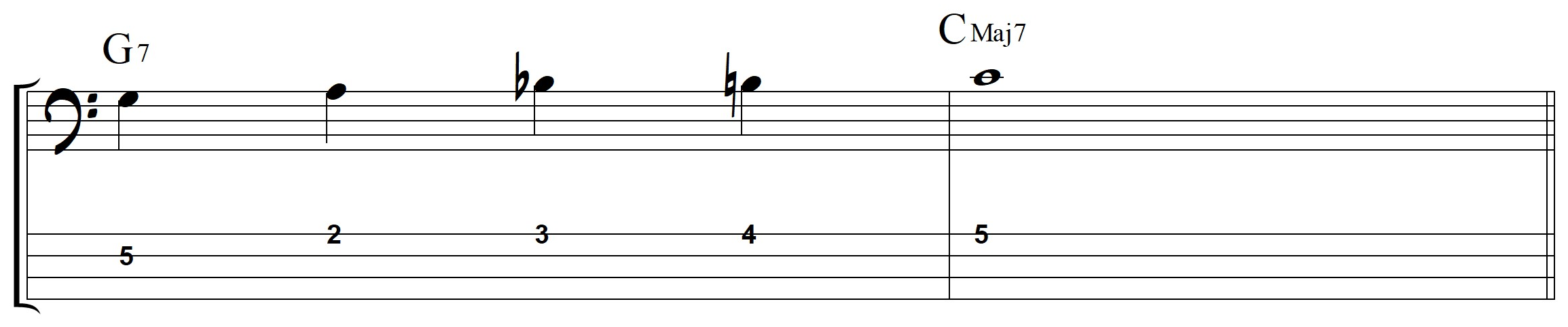
Here’s the shape. Starting on the root, we climb — root, second, minor third, major third — and that lands us on the root of the next chord, a fourth above. Or simpler still: play the root, then a three-fret lead-up into the next chord’s root.
And here’s the clever part. That move — up a fourth to the next chord — is everywhere in this progression. Am7 to Dm7 is up a fourth. Dm7 to G7, up a fourth. G7 to Cmaj7, up a fourth. Movement by a fourth is the most common chord movement in all of Western music, so this one little line goes a very long way. We stop seeing two separate chords and start seeing one journey.
Over Am7 heading to Dm7, that line is:
A – B – C – C♯ – (D)
Five notes: root, second, minor third, major third, landing on the D as the next bar begins. Learn it two ways — first across two strings, the easy, comfortable fingering; then on one string, sliding up, which is brilliant for feeling the distances on the fretboard.
Then put it to use. First over just the Am7 bar, walking into the Dm7, everything else staying two-feel — only that one bar walks. Then move the same shape to the Dm7 bar (D E F F♯ into G) and the G7 bar (G A B♭ B into C).
And now the fun part — combinations. Try walking Am7 and G7 with two-feel in between. Then try Am7, Dm7 and G7 all walking, one flowing ascent through the whole progression. That’s real walking bass — and it came from one five-note shape you learned in about a minute.


Phrase 2: the descending line
The ascending line is fantastic — but it only ever takes us up. Sometimes you want to come back down. So we need a second phrase: a descending line for those same minor 7 and dominant 7 chords.
Here’s the neat bit. We’re still connecting the same two chords a fourth apart — Am7 to Dm7 — but instead of climbing up a fourth to the D above, we descend to the D below. There’s a lovely piece of logic that makes this work: going up a perfect fourth and going down a perfect fifth land you on the same note, an octave apart. A chord moving up a fourth is a fifth going down. Don’t worry about the theory — just know it works.
Starting from the root, the shape moves down — root, flat seven, six, flat six, down to the five — landing on the root of the next chord an octave lower. Over Am7 heading down to Dm7, that’s:
A – G – E – E♭ – (D)
It’s the mirror image of the ascending one — a line that travels downward into the next chord. Learn it across two strings and on one string, exactly as before, then apply it over D7 and G7 in isolation first.
Then combine. Mix a descending bar in with your two-feel, and with the ascending phrase from before. Now you’ve got a choice in both directions — and that’s the point. Two phrases, one up, one down, is already a real vocabulary. Two words in your musical speech. You don’t need to think about chord tones or scales to use them — just accept that they work over the minor 7 and dominant 7 chords, and choose which one fits the direction you want to go.
And here’s the thing worth saying plainly: this is also exactly how it works once you do know the theory. Pros aren’t calculating scales on every beat — they’re reaching for words they’ve collected, the same way you’re doing right now.


Phrases 3 & 4: lines for Cmaj7 to Am7
Those first two phrases cover the minor 7 and dominant 7 chords moving by a fourth. But our progression has one other move in it: Cmaj7 to Am7 — chord one to chord six. That’s a different root movement, so it wants its own vocabulary.
We’ll learn two lines for this move — a descending one and an ascending one — so once again you’ve got the choice of direction. Learn each across two strings and on one string, exactly as before, then start dropping them into your two-feel over the Cmaj7 bar: sometimes walking down into the Am7, sometimes up.
Now you’ve got vocabulary for every move in the progression — the fourth-movement phrases for Am7, Dm7 and G7, and these two for Cmaj7 to Am7.


Putting it all together
So here’s where it goes. Start in a plain two-feel — roots and fifths, nice and simple. Then, bar by bar, start adding phrases: an ascending line here, a descending one there, mixing directions, choosing as you go — until it turns into a full, flowing walking line over the whole 1–6–2–5.
Listen to how it grows out of the foundation. Nothing sudden. Just choices, added one at a time. That’s walking bass vocabulary: two-feel as your home, a handful of phrases that work, and the choice of when and which direction to use them. Learn a few more over the coming weeks and your vocabulary grows — and with it, your freedom. That’s how every walking bassist you admire actually plays.
Want the complete vocabulary?
These four phrases are just the start. Simple Steps To Walking Bass gives you dozens of phrases for every chord movement, over full progressions and real tunes — building all the way to confident, flowing lines. This lesson is the very first step on that path; the course walks you the whole way.
This week only — 30% off. I don’t run this offer often, so if walking bass has clicked for you, now’s the time.
Not ready for the course? No problem at all — grab the free backing tracks and fretboard diagrams above, get these phrases under your fingers, and let me know in the comments how you get on. Either way: pick up your bass, learn a couple of words, and start speaking. See you in the next one.