The RIGHT Way To Start Walking Bass (NO Theory Needed)
So, walking bass is one of those things that sounds impossibly complicated when you hear a great player do it — that endless, flowing line that just keeps moving and never seems to run out of ideas. And most bass players assume you need years of theory, a head full of scales and arpeggios, and a jazz degree before you can even start.
You don’t.
In this lesson I’ll show you the perfect way to begin — the foundation step that almost nobody starts with, but that makes everything after it fall into place. We’ll build our very first line over eight bars of one of the most famous jazz progressions ever written, and at no point do you need to think about scales or arpeggios. Not once.
And by the end, you’ll also understand why this is genuinely one of the best things you can practise for learning the entire fretboard — whatever style you actually play.
This lesson is a taste of Simple Steps To Walking Bass
The complete step-by-step method — 30% off this week. See the course →
Why most players start walking bass the wrong way
Here’s the mistake nearly everyone makes: they try to play a full, busy walking line straight away — four notes to the bar, moving constantly — and they get overwhelmed. There’s too much to think about at once, so they either freeze or fall back on memorising someone else’s line without understanding it.
The fix is to slow right down and build the line in layers. Before you walk, you learn to outline the chords with just one or two well-chosen notes per bar. That’s the foundation. Get that solid, and adding the movement later is easy — because the framework is already there.
The eight bars we’ll use
We’re working with the opening of a jazz standard you’ll almost certainly recognise once you hear it — it’s a rite of passage for every jazz musician on the planet. It’s the perfect training ground because it moves through a really common set of chord relationships that turn up in tune after tune. One chord per bar:
Cm7 — F7 — B♭Maj7 — E♭Maj7 — Am7♭5 — D7 — Gm7 — G7
Don’t panic at those chord symbols. We’re not going to analyse them — we’re just going to use them as signposts. Each one tells us a landing note, and that’s all we need to begin.
🎵 Practise-along backing tracks
Play along at three tempos. Start slow — there’s no prize for rushing.
130 bpm
150 bpm
180 bpm
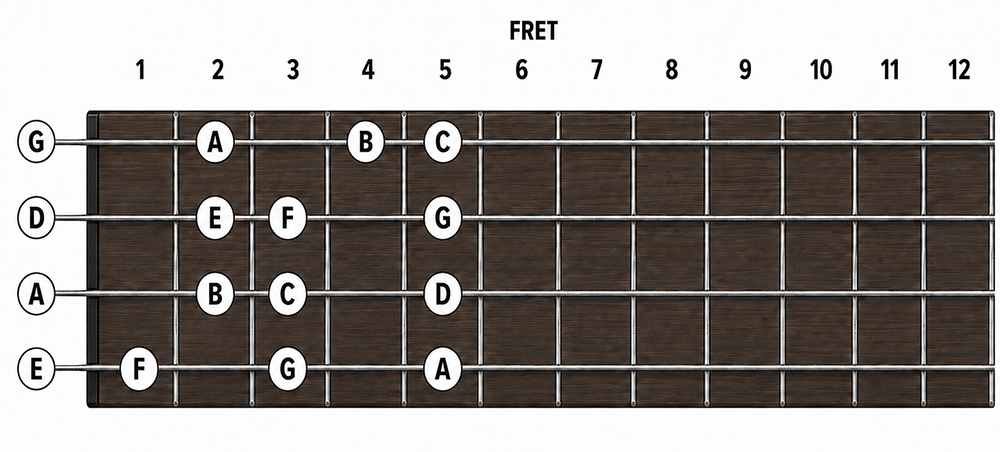
The download also includes full fretboard diagrams showing every note on the bass — perfect for finding your roots and fifths anywhere on the neck as you work through the lesson.
⬇️ Download all lesson material (tracks + fretboard reference)
Layer 1: Root notes only
Step one is the simplest possible line: one note per bar, and that note is the root of the chord — just the note the chord is named after. Cm7, the root is C. F7, the root is F. And so on all the way through: C, F, B♭, E♭, A, D, G, G.
That’s your whole line for now. One root per bar, right on beat one, and let it ring. Start in a low position — everything in the first five frets — and simply hunt for each root on the fretboard. This is the bit I really want you to take away even if you never play a note of jazz: you’re taking a chord symbol and finding where that note lives. Do that across dozens of tunes and your fretboard knowledge goes through the roof. That’s why walking bass is fantastic practice for any bass player who wants to actually know their instrument.
Once that’s comfortable, here’s your first taste of what walking bass really is: choice. You don’t have to play every root in the same low octave. For some bars you could jump up and grab the root an octave higher. There’s no right answer — you decide, do I go up, or do I go down? That single decision is the most important thing in walking bass. Every choice you make later, however complex the line, comes back to that one question.
Layer 2: Adding the fifth
Now let’s fill some space by adding one more note per bar — the fifth. If the theory means nothing to you, here’s all you need: a perfect fifth is a note seven frets up from the root, or the same note five frets up on the next string. You don’t need to know a single scale to find it.
There’s one exception, and it’s the only real thinking in the whole lesson. Bar five is Am7♭5 — that “♭5” means the fifth is flattened, so we drop it by one fret. Everywhere else, normal fifth; just that one bar gets the flat five.
So the pattern becomes: root on beat one, fifth on beat three. Two notes a bar — and it immediately sounds more like a real line. And again, you’ve got choices: the fifth doesn’t have to be above the root, you can play it below instead. Sometimes up sounds right, sometimes dropping underneath keeps the line smooth. Up, or down — there’s that question again.
Layer 3: Chromatic approach notes
Here’s where it starts to sound properly like jazz — still no scales, still no arpeggios. The trick great players use constantly is to lead into the next root with a note just one fret away, so it slides right into the target. It’s called a chromatic approach note, and the magic is that it doesn’t matter what the note is or what key you’re in: one fret above or below your target will always pull towards it and sound great.
On beats three and four, instead of just sitting on the fifth, walk down (or up) into the next bar’s root: a note two frets above the target, then one fret above, then land on the root right on beat one.
Important: don’t do this every single bar — that’s the mistake people make, and it gets busy and mechanical. Just drop one in every now and then, wherever you fancy a bit of forward motion. Let the line breathe.
Putting it all together
That’s a genuine, functioning walking bass line — built from just four ingredients: roots, fifths, single-fret approach notes, and the constant up-or-down choice. Nothing you couldn’t have worked out from what we’ve covered here. From here you can move all around the fretboard, take some roots high and some low, mix your fifths above and below, and drop approaches in and out as you feel them.
Walking bass isn’t about knowing more. It’s about making choices with a small set of tools — and the more you practise finding those roots and fifths across the neck, the better you know your fretboard, full stop.
Ready for the complete method?
These eight bars are just the beginning. Simple Steps To Walking Bass takes you from these first root notes all the way to confident, flowing lines over any progression — full choruses, proper voice leading, and walking lines over dozens of standards. It’s the complete, step-by-step path from where this lesson stops.
For this week only — 30% off.
Whether you jump into the course or just work these eight bars on your own, the important thing is to pick up your bass, find those roots, and start making choices. That’s walking bass — and now you know where to start.