
Why EVERY Bass Player Should Learn About Chord Tones
In this lesson,I’m going to talk about why I think every bass player should work on an understanding and knowledge of chord tones and chord construction.
Every piece we play contains a harmonic background of some kind. This is the ‘chord progression’. When we create a bass line for a tune it’s our functional role as a bass player to outline that harmony and to do this we need to play around a framework of chord tones. The notes of the chords.
If you’ve ever found yourself stuck playing simple root notes as a bass line and want to introduce some extra notes for interest. Chord tones are your friend.
What Are Chord Tones And Why Are They Important?
As the name suggests, chord tones are the notes within a chord. You may already know them by the term arpeggio. This is an ordered collection of chord tones. Chord Tones – individual notes within a chord Arpeggio – The ordering of notes within a chord In general Western music, the majority of what we play is made up of chord progressions. These can either be played as chords or implied through a melody. All pieces of music have a harmonic background that dictates everything we play or write in a bass line or melody.
Creating A Bass Line From A Chord Chart
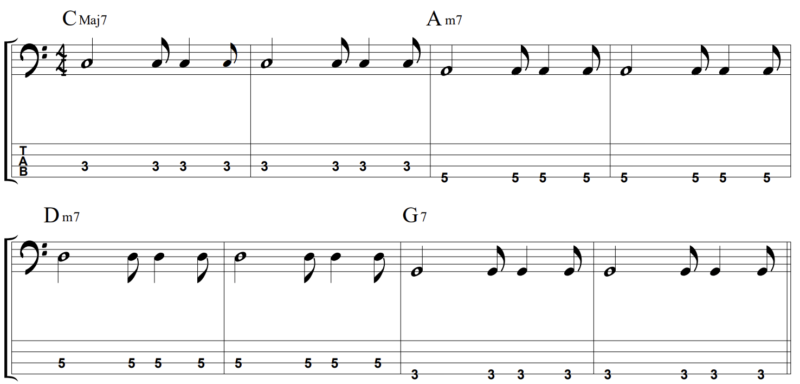
As a bass player, you will probably get asked to come up with a bass line from a basic chord chart at some point or another. In this situation, the safest thing that most players do is go for the root notes. This is absolutely fine and is what will be expected of you most of the time, but you might want to make your lines a bit more interesting. This is where chord tones come in handy. Instead of being restricted to the first note of the chord (the root), you have access to a variety of tones that can help you outline the harmony. If we harmonise the C major scale, we can see what tones are within each chord: C Major 7 – C E G B D Minor 7 – D F A C E Minor 7 – E G B D F Major 7 – F A C E G Dominant 7 – G B D F A Minor 7 – A C E G B Minor 7 b5 – B D F A Now, let’s apply this to a I vi ii V chord progression. The firstexample below shows a bass line that sticks to the root notes and the secondexample uses other chord tones to better outline the harmony. Root Note Bass Line
Chord Tone Bass Line
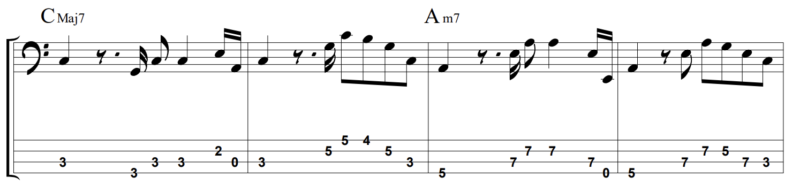
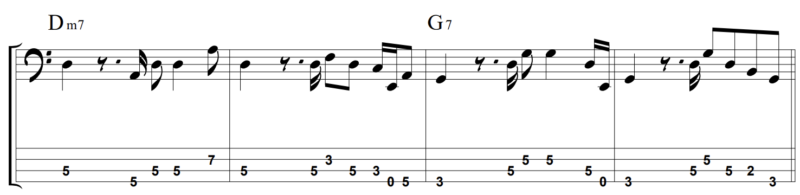
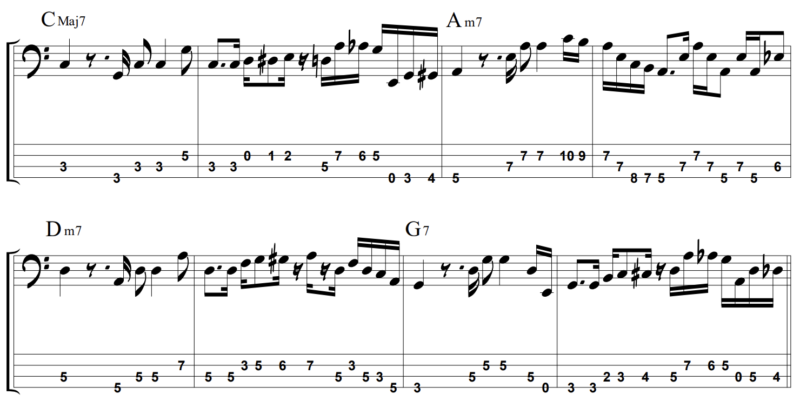
Notice how the second example sounds so much more interesting as it moves around and contains more harmonic information to better support each chord. The tones we used in this line all work because they are consonant, not dissonant. Consonance – When notes blend and work together nicely Dissonance – When notes clash and don’t sound as pleasing when played together However, sticking to chord tones all the time can become a bit bland. To spice things up, you can add non-chordtones into the mix. These have to be used carefully to avoid clashing with the harmony, so you need to know how to use them properly before you start chucking them in everywhere. Non-chord tones work well as they create a bit of tension that is released by playing a tone within the chord. Here is the same chord progression again with a bass line that uses non-chord tones to add a bit of tension and release.Non-Chord Tone Bass Line





Re-Inspired to go back to the Chord Tone Course!
How much is the Chord Tone course going to be?
The course will be $69
Where do I find this cord tone lesson on TalkingBass?
Mark, I have taken three of your courses already, Beginners Course, Bassic Fundamentals and
Simple Steps To Sight Reading.. Would Chord Tone Essentials be the next one on the list I should take?
Hi Ricky. Yes, Chord Tone Essentials would be the perfect next step for you. Hope you like it!