The Scale Mistake Every Bass Player Makes – FIXED!!
The Scale Mistake Every Bass Player Makes – FIXED!!
Most bass players learn scales. Far fewer know how to actually use them.
If you’ve ever run through a scale and thought “that sounds rubbish as a bass line” — you’re not wrong. A scale on its own isn’t music. Running up and down one isn’t music either. So what’s missing?
The answer is HARMONY. Specifically, the relationship between scales and chords.
Here’s the key insight: great bass lines aren’t built from random notes picked out of a scale. They’re built from chord tones — and scales are what you use to connect and decorate around them. Think of chord tones as the destination, and the scale as the road that gets you there.
In the video above, I walk you through a simple three-step method:
- Start with the chord tones — identify the root, third, and fifth of whatever chord you’re playing over. These are your target notes.
- Use the scale to connect and embellish — passing notes and neighbour notes are what turn a static arpeggio into a flowing bass line.
- Think rhythmically — pitch without rhythm is just noise. Put those notes into a groove and suddenly you’ve got something.
Once you start thinking chord tones first and scales second, everything clicks into place.
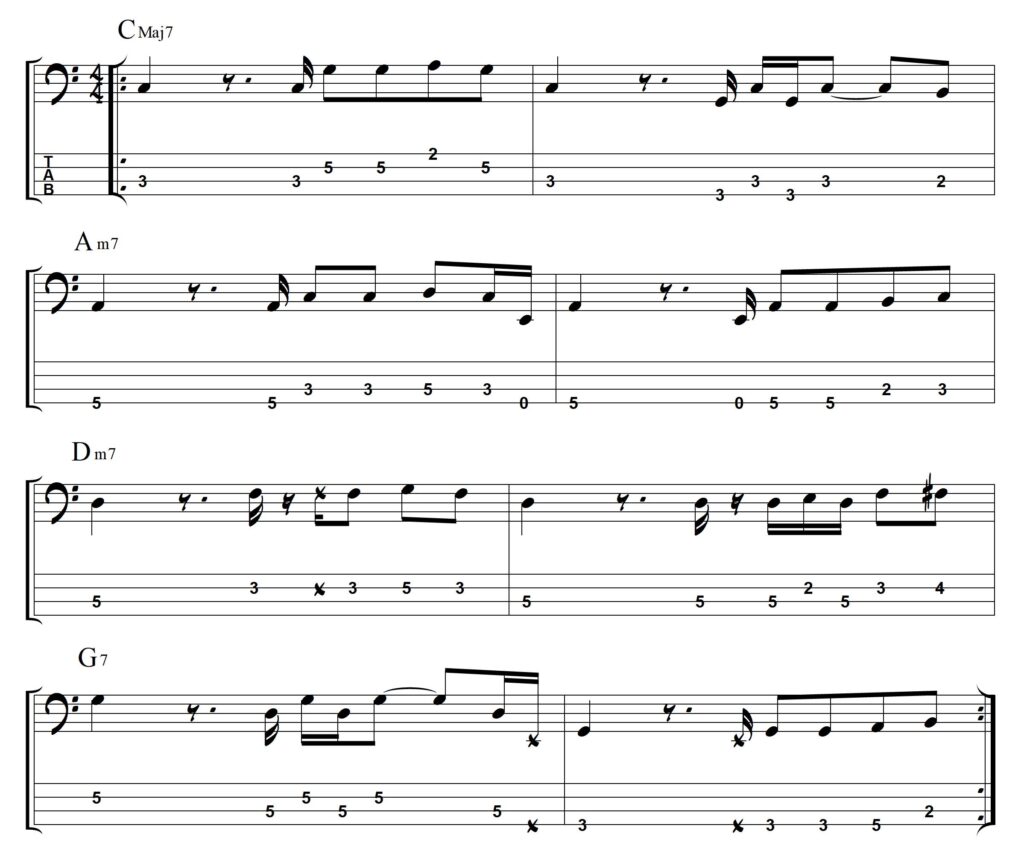
Check out this bass line demonstration of how you can use Passing Notes and Neighbour Notes to add melodic interest to a bass line working through a chord progression: