
Creating Basslines – Bass Drum Patterns
This is the first in a series of lessons devoted to creating your own basslines. This lesson deals with doubling the bass drum pattern of a song and the pedalling rock style.
Lesson Plan
Today we will focus on creating riffs from a linear perspective rather than the short motif style explored in the creating bass riffs lessons. While focussing on rhythm, this lesson will cover:
- Where to start when creating a bass line
- How to double the kick drum pattern to find the rhythm
- How to adapt the rhythm to get the right feel for a track
Creating A Part From A Chord Chart
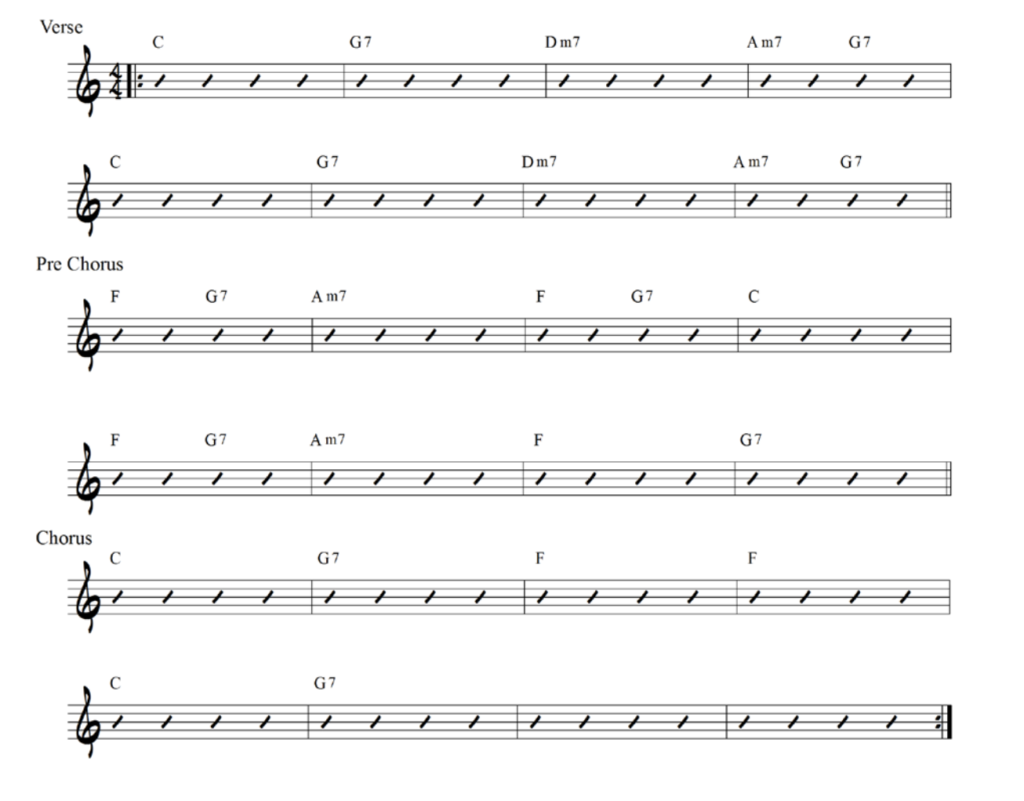
Imagine you have been given the following chord chart at a gig and need to come up with a suitable bass line:
Practice Track
Breakdown
Firstly, make a note of the elements you can’t change, including the:
- Key
- Style and feel
- Tempo
- Chord progression
In our chord chart, these are:
- Key – C major
- Style – Straight pop
- Tempo – 110bpm
Chord Progression:Intro [: I | V | ii | vi V :]Pre Chorus IV V | vi | IV V | I IV V | vi | IV | V Chorus I | V | IV | IV I | V | V | V
Kick Drum
To begin building a bass line, you need to know what rhythmic pattern you need. The kick drum pattern will give you an indication of the groove and can be doubled on bass to solidify the rhythm. If we pick apart the first drum pattern from the video we get this: (1) + 2 (+) (3) + 4 + ( ) = Kick drum beat From this, we can build a basic bass line using just the root notes from the chart. The video has a few examples of how different kick drum patterns depict a different feel on the bass. Have a play through them to see how changing the rhythm can give a completely new feel to the original chord progression.
Note Length
Rhythm isn’t just about note placement, it also includes note length. The amount of time you hold a note for has a huge effect on the overall feel of a song. There are two main ways to play a note, they are: Legato – Holding a note for its full length Staccato – Cutting a note off short These are both extremes and it is much more common to play somewhere in the middle and end a note just before the next. Have a play around with different note lengths to get a feel for when each one would work best.





boss, thnxz for the lesson..and i will be greatful to u, if u upload a pdf file or detail video about how syncopation comes, demonstrating how to achieve syncopation in relation to drum..realy i needs d subbdivision of beat in syncopation technique
Really good lesson, cheers
i cant belive i am really learning
great lesson bro i love ur work but can u add the fills on the tab sheet it wil really help me a lot.thnx
awesome way to focus on the basics;)
Mark ,
Superior training. I have a question? I have purchased a Dean (Acoustic /Electric bass), watching utube video a presenter recommended a pre ammp because of a pizeo pickup so it wouldn’t sound tinny as it would if you just used a regular amp.
Could you recommend a a inexpensive practice amp that integrated a preamp in its amplifier. please forward your reply to my email
drraymondvelladc@yahoo.com
Thanks
Mark, thank you so much for you valuable bass lessons, bless you for helping those who can’t really afford music lessons but want to learn to play. Finally unzipped the blues and chord lessons. This is clearing up a lot for me on how to get into different groves. Bless you in what you do. Thanx a lot. Peace!!
eaahm,. where is the backing track from the beginnig? could rly use this,.. and great stuff that you do i cant give enough thanks!
gold
is there any lessons on working out what notes to choose for chord progressions. i been playing for years and im still stuck on root/5th/octave
Great lesson lots of lnformation simple clear and to the point Thanks