
Beginner Bass Guitar Lesson – First Lesson Absolute Basics (New Version)
Welcome to your FIRST EVER BASS LESSON!! This lesson is taken from the all new and updated Beginner Bass Guitar Course here at Talkingbass. Click Here To Continue The Course
Anatomy Of The Bass Guitar
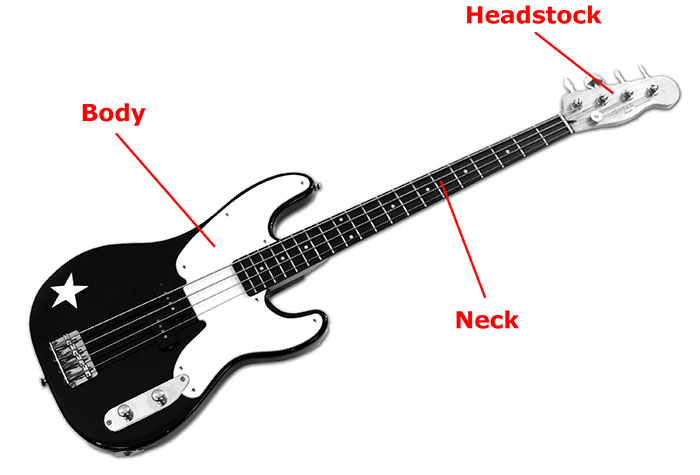
First of all, let’s have a look at the basic anatomy of the bass. The following diagram gives an overview of the three main parts of the bass guitar. The body, the neck and the headstock:
Bass Hardware
Beyond the basic body, neck and headstock we also have several additional pieces of hardware attached to the instrument that we need to cover. The following diagrams display the standard parts found on most regular bass guitar bodies:
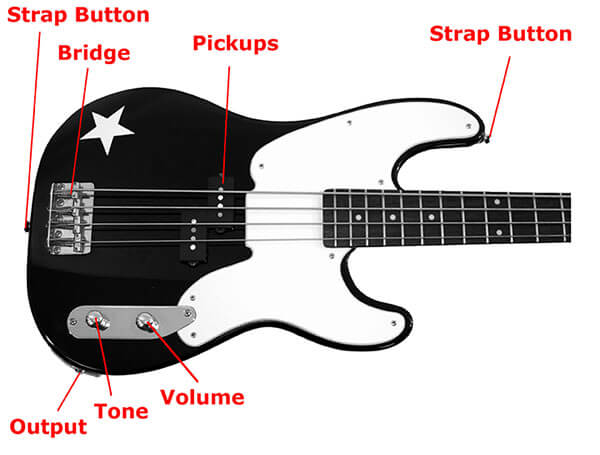
- Strap Button – Used to attach the strap to the bass
- Bridge – Secures strings to the body of the bass
- Pickup – ‘Picks up’ the sound of the bass strings
- Output – Connect lead here for sending signal to the amplifier
- Volume – Adjusts the bass volume
- Tone – Adjusts the bass tone (bass/treble)
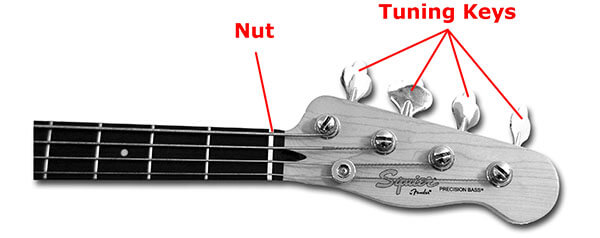
- Nut – Sets the height and spacing of the strings
- Tuning Keys – Adjusts the tension and pitch of each string
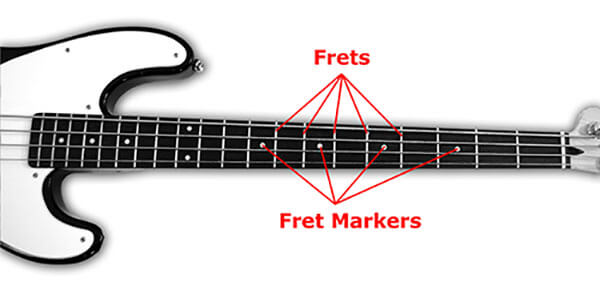
- Frets – Divide the neck into notes. Each fret corresponds to a different note.
- Fret Markers – Used for easier navigation of the fretboard.
The Amplifier
To hear the sound of a bass guitar you need to plug into an amplifier with a lead. The most common type of amp used by beginners is the combo:
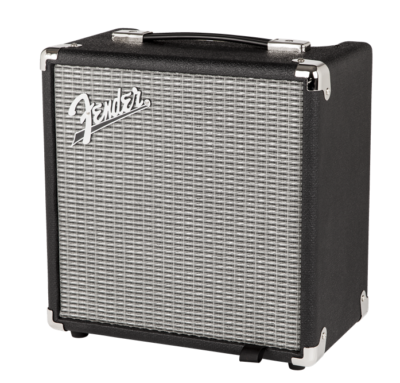
A combo contains an electronic amplifier and speaker. This is a combination hence the name Combo. All bass amplifiers will have an input socket (where you plug your lead in) and a variety of knobs. These range from basic volume and tone controls through to effects and graphics equalizers. Here we see a common control panel found on a basic combo:

The most important controls for now will be the Volume control often labelled as Master. Just begin by setting this at about 9‘o clock (quarter of the way around) so you’ll hear some sound when you plug in. Then set everything else to 12 o clock (half way). You can experiment with these other controls and set them to your taste later. To get started with playing, you can just plug a lead into the bass (the output socket), plug the other end into the amplifier input and you’re good to go!
Holding The Bass
There are two ways to play the bass: seated and stood. If you are seated, just place the bass on either thigh. The curved contour in the body will match the curve of the leg. The right thigh is the most common for most beginners but I personally prefer the left thigh. This mimics the posture when stood more closely and allows for an easier stretch in the fingers. This is the common ‘classical’ or ‘spanish’ guitar posture.
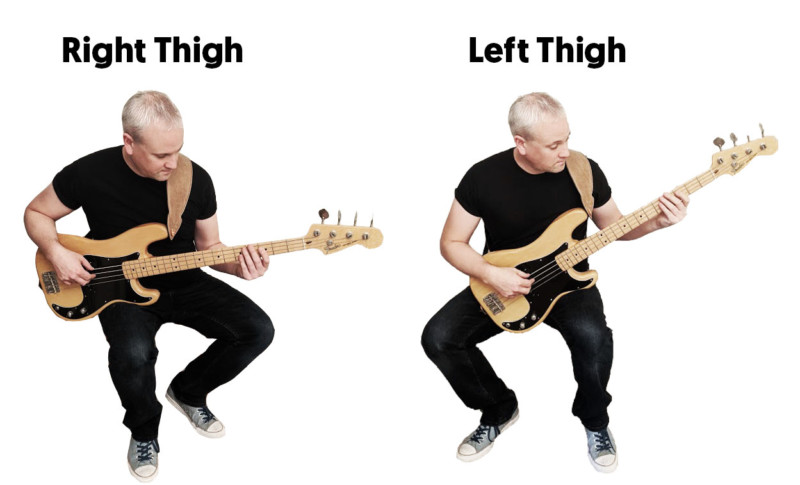
A good starting position for the hands is to simply:
- Place the thumb of the left hand in the back of the neck
- Place the left hand fingers over the fretboard ready to press down on the strings
- Place the thumb of the right hand on the pickup
(switch these around if you are left handed)
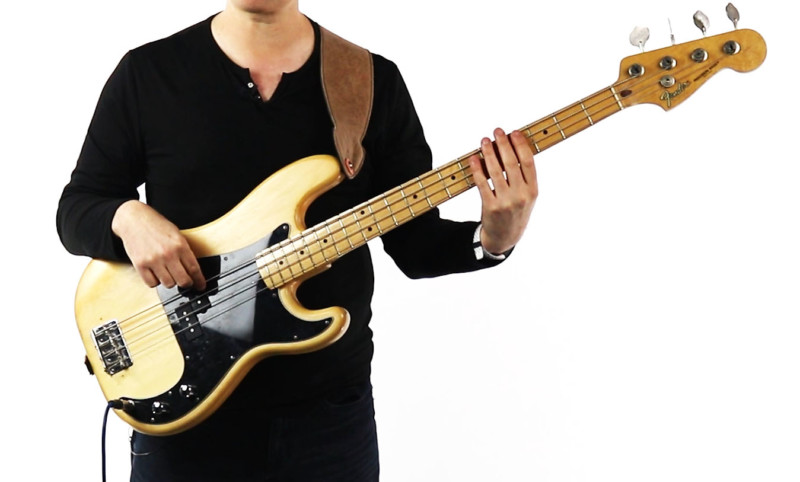
To stand with the bass, you will need to use a strap. If you have a strap simply attach it to the strappegs, thick part at the neck end (the horn) and the long thinner part at the bridge end.
The Strap
If we’re going to stand with the bass, we need to attach a bass strap. These are really easy to fit to the instrument. We just push the strap buttons through the holes on the strap.
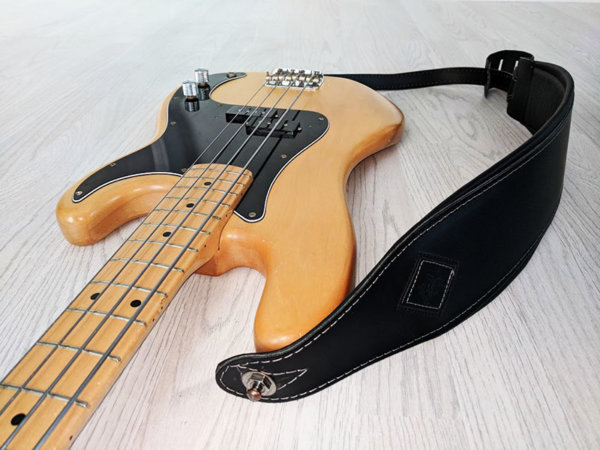
Important Tip: Aim to set the strap height so that the bass is at the same position whether you are stood or sat. Also be sure to avoid any positioning that forces you into bending too much at the wrist. You don’t want to be adding unnecessary pressure to the tendons.
Strings Of The Bass Guitar
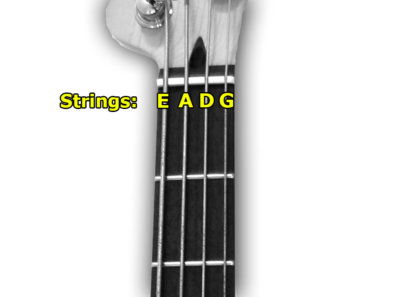
The strings of the bass guitar are named according to the standard tuning of each open string. They are (from thickest to thinnest): The E String,A String, D String and G String:
Plucking & Choking
When plucking a string, simply place the finger on the string and then bring the finger back into the thumb (or next string). To choke the note, simply place the finger back on the string. Exercise: Pluck and choke each open string in turn. The thumb of the right hand can mute any unwanted noise on lower strings. This is something you will work on as you develop and progress.
Tuning The Bass
The tuning pegs are used to change the tension of a string. On most common bass guitars the tuning pegs perform the following function:
- Turn Clockwise To Loosen The String (lower the pitch)
- Turn Counter Clockwise To Tighten The String (raise the pitch)
Be warned: Tightening the string too much will eventually result in a snapped string! Tune the bass as shown in the video. Use the supplied Open String Reference Tone audio files to tune each string in turn:
Reference Tones:
E String
A String
D String
G String
Fret Numbers and Markers
The frets of the bass guitar neck are numbered in ascending order from the headstock to the body as follows:
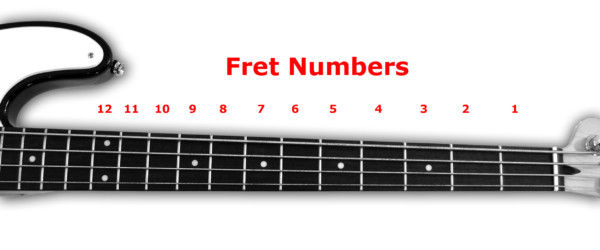
The following diagram displays the fret number of each fret marker on the neck up to the 12th fret (double fret marker):
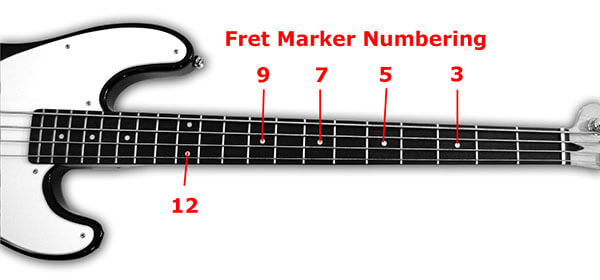
To fret a note, press the string down just behind the required fret. Don’t press down on the actual fret. This will result in rattle, buzz and poor tone. Exercise: Practice playing at different frets over the entire bass fretboard
Your First Bass Riff
Play the following notes in a continuous rhythm as showing in the video: (All notes on the E String)
- Open String x2
- 3rd Fret x2
- 5th Fret x2
- 7th Fret x2
- Open String x2
- 3rd Fret x2
- 5th Fret x2
- 3rd Fret x1
- 2nd Fret x1

You are a legend!
It’s awesome
wow,,,,how nice to find this,,it’s awasome sir,,thanks alot,,,
It’s really helpful
I really like the site , the teachings are understandable
Nice one
Good evening everyone, am beginning today hope to have a positive comments soon
It’s so great. Thank you
What a fantastic site…thank you!
This is so Great
I’ve loved it
Thanks very much
Love the pace and clarity of the instructions. All much appreciated, thank you. 🤟😊
Thank you so much…. very very much.
Thank you
I gained a lot today
This is really wonderful
I’m a drummer by trade & for the past 17 years I’ve worked in the music department of a college for young people with Special Educational Needs. I wanted to increase my skills & the idea of playing bass (from a drummer’s perspective) seems to make more sense. So I’ve got myself a good cheap bass (to start with) and found some of the, ‘Talking Bass’ Beginners videos on You Tube. For a complete novice like me, I’ve found them massively helpful. The time taken to clearly explain & demonstrate each step is perfect for me. So even at the age of 57 there are always new challenges to take up and new music skills to learn! Thank you.
This is great. You are providing a great service to the world.
Although not new to bass as self taught from an acoustic guitar background I really appreciate the knowledge. Thank you
This lesson was really easy for a begginer like me! I am a 16 year old girl and I’ve always, always wanted to play the bass guitar but my friends said I don’t have the fingers for it. Well, I BEGGED my parents😀 and they finally got me a guitar and an amp😁😁. I intend to learn how to play before the lockdown ends but the problem is I have a 5 string guitar, so what are the names for all the strings, because the one in the picture has only 4 strings. Thanks.
so the tickest one is B then is E then A then D then G
this is from thickest to thinest
Sorry, I had to create a new account. I’m just seeing your reply, thank you soooooooo much Angel Vera. You’ve helped me a lot. Thankkkk yooooouuu😃
This is a great practice l love it
Just did my first session as an absolute novice. Most helpful and looking forward to moving on to the next session. Excellent, thank you.
Really helpful. Thanks
I loved this lesson ! Straight to the point with solid examples and clear explanation
Thanks for sharing your knowledge and techniques sir!
I am 69 years old and love this site with my first Bass.
Very helpful.
Awesome!
I love this session
great stuff, I am a drummer going for bass
Just ordered my first bass, can’t wait to excercise with the help of this fantastic site. Thank you so much!
Have purchased a new Bass not played for a long time 60s very impressed with the
presentation, looking forward to the sessions..
Very nice lesson.. Really appreciated all efforts made in making my dream a reality
I am a young 71, used to tinker on a guitar when I was a teenager played mostly by ear – stopped when severed a tendon and lost use of my small finger. Since lockdown with the virus, I decided to try bass, looked a lot of videos on youtube, Found your channel and you were easy to understand because of the way you explained and demonstrated. Like most, I guess went straight to the section on how to learn/ play simple intro riffs ( gives self-encouragement). Got the bug and now starting from the beginning and intend to work my way through
I’m
Thanks for the lessons
Very helpful
Really appreciate. It’s helpful indeed
Thank you so much!
Thank you very much sir, I like the way you teach bass
Mauliate lae, tetap semangat.
This is nice…So helpful
SO GRATEFUL
Nice… These has helped me alot
Very helpful
Good introduction to the Bass Guitar Instrument , very helpful .
Thank you!
I’m very grateful!
Wow thank you very much, your methods are simple and easily understood, its a interesting course indeed
Love it 😍❤️❤️
Thank you.
This lesson was really easy for a begginer like me! I am a 16 year old girl and I’ve always, always wanted to play the bass guitar but my friends said I don’t have the fingers for it. Well, I BEGGED my parents😀 and they finally got me a guitar and an amp😁😁. I intend to learn how to play before the lockdown ends but the problem is I have a 5 string guitar, so what are the names for all the strings, because the one in the picture has only 4 strings. Thanks.
so the tickest one is B then is E then A then D then G
this is from thickest to thinest
This is good
Thank Goodness I’m in the right place. I’m enjoying the teaching. Thanks
I like the little Bass riff
Thank you so much 🙏….
I am so glad I found this site ,for the fist time …I love it thanks.
the real deal.
Thanks.
Really helpful for a starter, thank you 👍😀
This is very helpful. Thank you!
Tanx alot it helpful
It really amazing
Sure this is very helpful
Hello, this is my first post, just to say thank you so much Mark, you are a star, I’m 46 years old and always been a keyboards/pianist. Have fancied learning the bass for some time now and just bought an Ibanez sr300e 4 string to practice on, following marks tutorials and vids on YouTube is helping me to learn the basics and fundamentals of the instrument.
Again, Mark if your reading these, thank you so much my friend, if I had more money if would give you some 😀
Really enjoyed myself. You’ve made it easier than I imagined. Keep doing more
Stupid question/s: Should I be having short nails, and I mean SHORT nails? I’ve got 1mm short nails, and I notice a lot of rattle when picking…surely I cannot be choking all the time after picking, right?
Also when doing the very first recommended frets (the basic riff on the E string), I notice there is a rattle when I lift my left finger from the fret—-how can i avoid this rattle?
I loved this lesson ! Straight to the point with solid examples and clear explanation
Thanks for sharing your knowledge and techniques sir!
Thanks alot
It really good being here
And it has given some basics
A well self explanatory piece, more wisdom to u sir and thanks for sharing with us.
I really liked this page
I believe al learn the staff and know it better
I express my happiness with TalkingBass
I am happy to be part of this commission!
I hope to learn better and new things
Thanks for the lesson
Thanks guys this was so helpful to me
Hi Mark and everyone!
I’ve always liked the bass sound and sine retiring from the workforce, I decided to add ‘playing bass’ to my bucket list. I had heart surgery in ’07 and have been recently been diagnosed with COPD. I am so very much wanting to learn. I have watched an extraordinary amount of videos on playing bass, and I kept coming back to Talking Bass! I hope to grasp all I can to play well. Thank you for this opportunity.
so the tickest one is B then is E then A then D then G
this is from thickest to thinest
This is nice I’m learning something
this lesson is cool
Old dogs and new tricks! Have been playing bass for nearly 50 years and in COVID lock-down doing a bit of a chops review to fill some gaps. After going through a few lessons, decided to join, and initially have a look to see how it all starts out. Excellent presentations and clarity. In lesson one, the idea of resting the bass on the “other” leg while seated to put it into a position closer to where it hangs on strap when standing was news to me! So ALWAYS something to learn. Hats off to Mark!
Perfect
Hmmnn am gradually enjoying it
This lesson was helpful thanks so much i really enjoyed it, and the explanation was also clear
I was very nervous at first but the lesson and instructions are at a lovely pace and easy to understand, which helped me to relax and above all enjoy my time with my new bass, at the end of the lesson I felt more confident handling my base and really enjoyed it, which is after all why I took it up in the first place. Looking forward to practicing and the next lesson
The one finger basic lesson is a very good start.
Christmas Day 2020, complete virgin to the bass, this instrument and myself have never crossed paths, stumbling across TB for bass lessons, like “wow”this is going to be a interesting journey. Watched the Beginner Bass Guitar Course, even more impressed. So all I have to do is saddle up, hold on tight and hope I don’t fall off through the journey
It’s so simple and very understandable. Thank you Sir Mark!
Great introduction to Talking Bass as a beginner. No fluff and straight into it, everything straight to the point and easy to understand, finishing with a simple riff to give encouragement. The reason people pick up an instrument is to learn how to play music on it, so finishing the first lesson with a simple riff is perfect. Your presentation style is professional whilst still keeping a friendly feel, so nice balance.
Great methodology – I don’t really consider myself a bass player though I have played in a hardcore punk band before. I decided to study the bass guitar formally for I am about to begin another project here in Lima, Peru.
You are the best
Love dis ,cool
Ooh WoW this is awesome… I love this 👍👍😻😻
Fun and easy to follow!,
Wow………I really like these lesson……….They are very useful……it is the best I know
To be honest, this website is amazing, I just picked up the bass guitar and before I knew it I started play a riff absolutely amazing
thanks this is awesome
This is very good to all of us that wan to move ahead we our skills, thank you very much.