
The 6 Essential 16th Note Rhythms You NEED To Learn!
16th notes are where a lot of bass players come unstuck. They’re the main hurdle in reading music, and they’re the heart of every syncopated funk line you’ve ever wanted to play. The good news? There are only six 16th note rhythms you actually need to know. Learn those six, and even the busiest funk groove turns into something you can count, read and feel.
In this lesson we’ll learn to count, play and hear each of the six rhythmic cells on their own, then combine them, and finally put them to work in a funky four bar riff in D minor.
Free download: 16th Note Combinations Practice Sheet
The printable rhythm sheet used in the video. Grab it before you start and keep it on your music stand.
What Are 16th Notes?
16th notes (or semiquavers, as we call them here in the UK and Europe) are what you get when you divide a single quarter note beat into four equal parts. They’re called 16th notes because that gives you sixteen of them in a bar of 4/4.
To count them, we use the standard “1 e & a” system. Each beat gets its number, followed by “e”, “and”, “a”:
| Subdivision | Notes per beat | How to count one bar of 4/4 |
|---|---|---|
| Quarter notes (crotchets) | 1 | 1 2 3 4 |
| 8th notes (quavers) | 2 | 1 & 2 & 3 & 4 & |
| 16th notes (semiquavers) | 4 | 1 e & a 2 e & a 3 e & a 4 e & a |
Warm-up: tap your foot (or click your fingers) on each beat and count the 16ths out loud along with it. Once that feels steady, practise switching between counting quarter notes, 8th notes and 16th notes, a bar of each, then randomly. You want to be able to shift between all three without the pulse wobbling.
In notation, 16th notes are joined by two beams (8th notes use one) and are usually grouped in fours, so you can see each beat as its own little block. That grouping is the key to everything that follows.
Why There Are Only Six Rhythms
It’s easy to think there are hundreds of possible 16th note rhythms, and if you look across a whole bar (or several bars) there are. But look at one beat at a time and it all simplifies. Leaving rests and ties aside for now, there are just six rhythmic cells:
- One cell with four notes
- Three cells with three notes
- Two cells with two notes
Every 16th note rhythm you’ll ever read is built from combinations of these six. Learn how each one counts, feels and sounds, and you’ve got your foundation.
How to practise each rhythm
Play everything on a single note (I use C at the 3rd fret of the A string) so there’s nothing to think about except rhythm. Keep your foot tapping on every beat throughout, then work through these four stages:
- Play the rhythm on every beat of the bar, counting the 16ths out loud.
- Play it on beats 1 and 3 only, resting on 2 and 4, still counting the 16ths.
- Go back to every beat, but now count only the quarter notes (“1, 2, 3, 4”).
- Beats 1 and 3 again, counting only the quarter notes.
Stages 3 and 4 take a bit of independence, because your voice, your foot and your hands are all doing different things. That’s exactly the skill you’re building. Playing a cell in isolation (stages 2 and 4) is what really teaches you where it sits against the beat.
The Six 16th Note Rhythms
Rhythm 1
Four 16th Notes
Count: 1 e & a. A note on every 16th.
The simplest one. Played on every beat it gives you a constant stream of 16ths. On beats 1 and 3 only, notice how your foot comes down immediately after the last note of each group: “1 e & a (foot) 2″.

Exercise A: on every beat

Exercise B: on beats 1 and 3
Rhythm 2
8th Note + Two 16ths: The Gallop
Count: 1 & a. Notes on the 1st, 3rd and 4th 16ths.
This is the classic gallop, and any Iron Maiden fans will know it instantly. When you drop the subdivision count and just count the beats, you’ll really feel that driving gallop come through.

Exercise A: on every beat

Exercise B: on beats 1 and 3
Rhythm 3
Two 16ths + 8th Note: The Reverse Gallop
Count: 1 e &. Notes on the 1st, 2nd and 3rd 16ths.
Another gallop, but flipped: the two quick notes come first and the held note comes last. It has a completely different character to Rhythm 2, so spend time getting to know how each one sounds.

Exercise A: on every beat

Exercise B: on beats 1 and 3
Rhythm 4
16th + 8th + 16th: The Syncopated One
Count: 1 e a. Notes on the 1st, 2nd and 4th 16ths.
This one sounds noticeably more syncopated, because the held note sits across the middle of the beat. Listen to the last note on the “a”: it pushes forward into the next beat. That’s true of any cell with a note on the final 16th, and noticing it is a great way to lock into the feel.
Counting “1 e a 2 e a” out loud gets breathless quite quickly, which is exactly why you want to learn the feel of this one, then play it with just the quarter note count.

Exercise A: on every beat

Exercise B: on beats 1 and 3
Rhythm 5
Dotted 8th + 16th
Count: 1 a. Notes on the 1st and 4th 16ths.
A dot adds half the note’s value again, so a dotted note is worth three of the next subdivision down. A dotted quarter note equals three 8ths, and a dotted 8th equals three 16ths. That’s why the second note lands on the “a”.
This is one of the most common figures in bass playing, and the thing to really understand is that the 16th comes just before the beat. You play the note, then your foot lands on its own. Get that relationship clear and a huge number of basslines suddenly make sense.

Exercise A: on every beat

Exercise B: on beats 1 and 3
Rhythm 6
16th + Dotted 8th
Count: 1 e. Notes on the 1st and 2nd 16ths.
The easiest of the lot. Two quick notes at the start of the beat, then you just let the second one ring. Nothing to wait for and nothing syncopated about it.

Exercise A: on every beat

Exercise B: on beats 1 and 3
Quick Reference: All Six Cells
| # | Rhythm | Count | Character |
|---|---|---|---|
| 1 | Four 16ths | 1 e & a | Constant, driving |
| 2 | 8th + two 16ths | 1 & a | The gallop |
| 3 | Two 16ths + 8th | 1 e & | The reverse gallop |
| 4 | 16th + 8th + 16th | 1 e a | Syncopated, pushes forward |
| 5 | Dotted 8th + 16th | 1 a | Last note leads into the next beat |
| 6 | 16th + dotted 8th | 1 e | Front-loaded, easy |
Step 2: Put the Cells Together
Once each cell feels familiar on its own, it’s time to combine them. The practice sheet below mixes the six cells into full bars. In the video I play the first four lines at 60bpm, but you don’t need a metronome or drum machine for this. As long as you’re keeping a steady count yourself, take it at whatever speed feels comfortable.
Download the 16th Note Combinations PDF
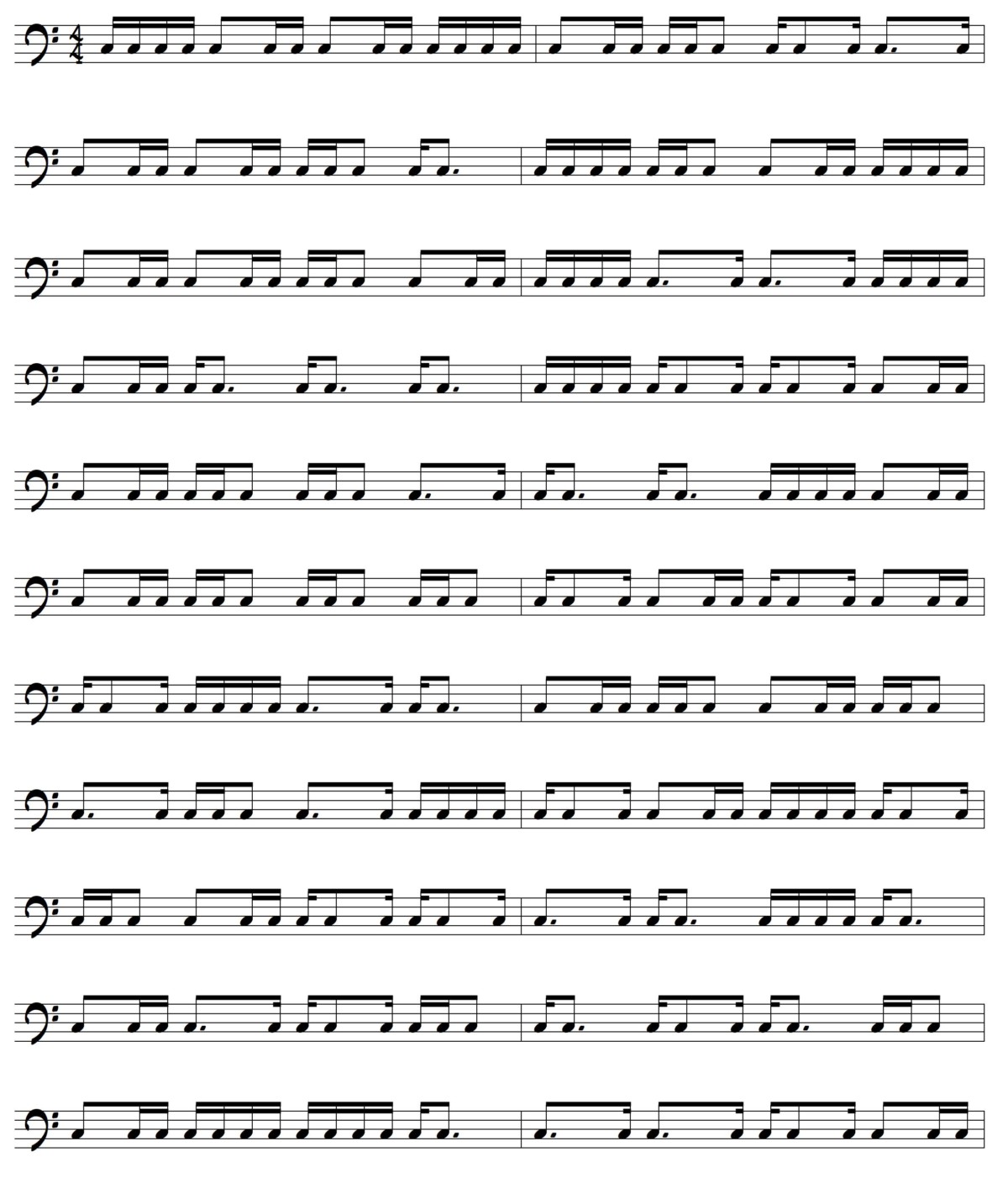
What about rests and ties?
These six cells aren’t the be-all and end-all of 16th notes. Once you add rests and ties, things can get a lot more complicated. But even the trickiest tied rhythm is still just a combination of these six cells, with some notes left out or held across. Get the six memorised and you’ll always have something solid to break a rhythm down into.
Step 3: Play a Real 16th Note Riff
Now let’s add some pitches. Here’s a funky four bar riff in D minor that uses all six cells. Play the practice track first and just listen, see if you can pick out the cells you’ve been working on as they go by.
Practice Track

Break it down: rhythm first
If 16ths are still new to you, take the pitches out of the equation completely. Play the whole riff on a single D (5th fret, A string) and focus on the rhythm, one beat at a time. Here’s how the riff breaks down into cells:
| Bar | Beat 1 | Beat 2 | Beat 3 | Beat 4 |
|---|---|---|---|---|
| 1 | #5 Dotted 8th + 16th | #3 Two 16ths + 8th | #5 Dotted 8th + 16th | #6 16th + dotted 8th |
| 2 | #5 Dotted 8th + 16th | #3 Two 16ths + 8th | #4 16th + 8th + 16th | #2 8th + two 16ths |
| 3 | Same as bar 1 | |||
| 4 | #5 Dotted 8th + 16th | #3 Two 16ths + 8th | #1 Four 16ths | #2 8th + two 16ths |
Loop each bar on its own until it’s comfortable, then play all four bars through. Notice that beats 1 and 2 are the same two-beat figure in every bar, so once you’ve got that, half the riff is done.
Recognise the cells, don’t just count them
The real goal here is to recognise each cell by its sound and feel, not to count every 16th in your head. When I see an 8th note followed by two 16ths, I don’t think “1 & a 2 & a”. I just know that’s the gallop and play it. Each cell has its own character, and once you know them, you can look at a bar and hear it straight away.
You still want to be able to count along, because when you get into more complicated tied rhythms it’s handy to break them down. But for everyday reading, knowing the cells by feel is what makes it fluent.
Now add the notes
The riff is written in standard notation only, with no TAB, and that’s deliberate. It sits comfortably around the 3rd to 7th frets, starting on D at the 5th fret of the A string, and I walk through every note in the video. Even so, it’s well worth working the notes out yourself from the notation. Because you’ve already done the rhythm work, it’s simply a case of attaching the right pitch to each rhythm.
And don’t worry about a metronome at this stage. As Jeff Berlin puts it, learn it out of time first. Get the notes under your fingers, work on the rhythms separately, then put them together. Build up a bit of speed, get comfortable, and then try it with the track.
Your practice plan
- Warm up by counting quarter notes, 8ths and 16ths against a steady foot tap.
- Work through all six cells on one note using the four-stage method.
- Work through the combinations sheet at a tempo you can play cleanly.
- Play the riff rhythm on a single D, one bar at a time.
- Work out the notes from the notation, out of time.
- Put it all together and play along with the practice track.
Want to take your reading further?
Simple Steps To Sight Reading
If standard notation is the sticking point, or you can play grooves like these by ear but struggle to read them, Simple Steps To Sight Reading takes you from the absolute basics of reading all the way through to professional standard sight reading, in simple, progressive steps.
Find out more16th Notes: Common Questions
How do you count 16th notes?
Split each beat into four and count “1 e & a, 2 e & a, 3 e & a, 4 e & a”. The number always falls on the beat, and “&” falls exactly halfway through it.
Are semiquavers the same as 16th notes?
Yes. “Semiquaver” is the British name and “16th note” is the American name for the same thing: a note worth a quarter of a beat in 4/4.
How many 16th note rhythms are there?
Within a single beat, and leaving rests and ties aside, there are six: one four-note cell, three three-note cells and two two-note cells. Longer rhythms are just combinations of these.
Do I need a metronome to practise this?
Not to begin with. Tapping your foot and counting out loud is enough to keep you honest. Once the rhythms feel solid, a metronome or the practice track is great for building consistency.
Keep Going
Ready for more 16th note work? These lessons are the perfect next step:
- The Most Important Funky Rhythm You’ll Ever Learn
- Funky Bass Riff: How To Count Tougher 16th Note Rhythms
- 3 Simple Bass Grooves To Improve Your Rhythm
- Sight Reading For Bass Guitar
And for hundreds more free lessons on every topic, head over to the Lesson Map, or sign up for free membership to unlock extra practice resources and downloads.




GENIAL GRACIAS
I’m not seeing a link to the rhythm worksheet(s).
Awesome lesson! Can you PLEASE do a tab and lesson for Flying Colors song Geronimo? It is an amazing Dave LaRue slap piece
Mark: Thank you, this is very useful. Well presented as always.
Great lesson. You are the best teacher Online.
Are there additional resources that work patterns such as this, as I can play grooves like this second nature, but need a TON of extra work on the reading aspect, pencilling the timing in above the 16 notes for example.