
Chromatic Technique Building Exercises
This lesson uses the chromatic scale to help build our technique concentrating on every movement of each finger.
What Is The Chromatic Scale?
The chromatic scale is a scale made up entirely of consecutive semitones played one after the other. On bass, this is played by going up just one fret every time. There is a whole array of different fingering and shapes that can be used when playing a chromatic scale, but for now we will stick to the one position.
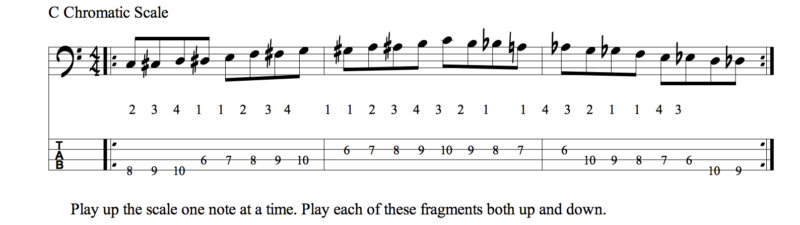
You will very rarely need to play a full chromatic scale in a song, but you will be surprised at how many techniques we can hone in on when we play it as an exercise. Here are a few suggestions for things to concentrate on:
- Left-hand positioning
- Left-hand fingering
- Thumb pivoting
- Right-hand positioning
- Alternate picking
- String crossing
- Crossing strings with the right-hand thumb
Left-Hand Technique
Positioning
Keeping your hand relaxed will make it easier to control your fingers and keep them close to the fretboard – if they fly around aimlessly then it will take more time for them to reach the next note and your speed will suffer. To help this, keep your fingers in a straight line and parallel to the frets. Try not to let your pinky drop down as you want it in position ready for action. You will need to bend your fingers slightly as the index and middle fingers are so much higher up than the pinky.
Fingering
The fingering we are using for this scale adopts the one-finger-per-fret rule – there are just a few position changes to remember along the way. Use the TAB above to work out the fingering and make note of the position shifts.
Right-Hand Technique
Positioning
The right hand should also be kept relaxed to avoid any unnecessary tension in the wrist. When you cross strings with the right hand, move the thumb across to the string below it. For example, if you jump from the A to the Dstring with your picking fingers, switch from the E to the Astring with your thumb.
Fingering
Alternate picking is another technique you can focus on with this exercise – just make sure you swap fingers each time. It is especially important to keep an eye out when you are changing strings as it is easy to slip up there.
Sequences
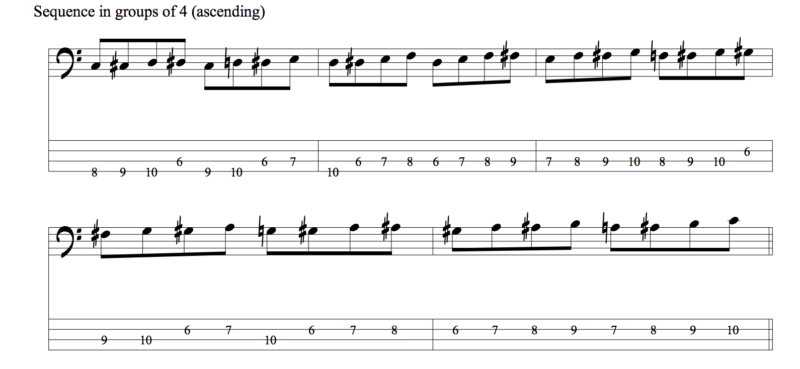
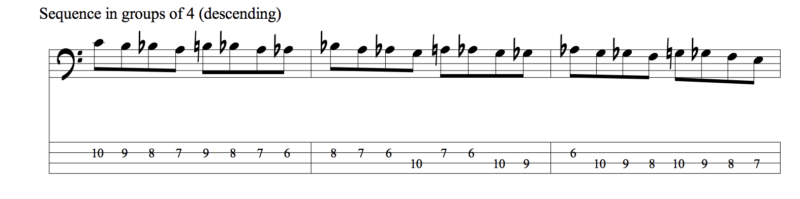
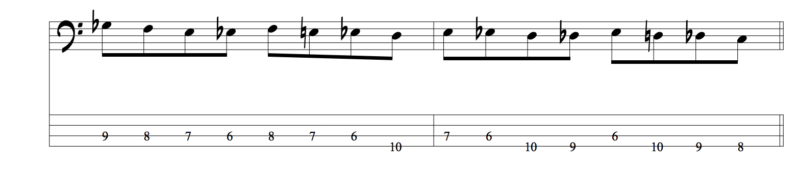
Making sequences out of scales is a great way to stop them becoming boring and further your understanding of the pattern. Underneath is an example of one sequence you can make out of the chromatic scale – you simply play fourscale degrees then go down a tone and repeat. Once you are comfortable with the pattern, use it to practise the other techniques discussed in this lesson – then try coming up with your own sequences!






Hi Mark,
Just wanted to say thanks for these lessons, they’re easily the best on the net.
Cheers
Jools
Hi Mark, I have to agree with Jools. Your lessons are excellent and easy to follow. I have learned lots and i look forward to more in 2015.
Happy Christmas
Martin
I put this in my daily practice rutine as warming up starting and works really well for fingers independences in the left hand .
Alternative Right hand plucking with this exercise works great too.
Even looking TV works !
I know that TV is not very helpful for focusing your brain, but this exercise does not require to much. Just Muscle memory !
great lesson again , thanks!!
Thank you talkingbass for giving me wonderful information about chromatic exercise
Muito grato pelas aulas!!