
Bass Scales: 5 Easy Bass Guitar Scales For Beginners
In this lesson I’m going to work through the 5 most useful scales for beginners (in my opinion)
In this lesson, we are going to look at five simple scales that are useful for developing a strong foundation for beginners to build from. We will learn one shape and cover one octave in each scale, but you should remember that this is just to get you started. There are many different ways to play every scale and playing around with alternative patterns will help you really understand the ‘ins and outs’ of each one. All scales on this page use C as the root note so you can easily compare them and understand what makes each one unique.
1. The Major Scale
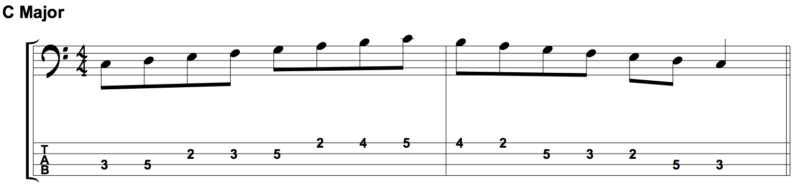
Scale Degrees 1 2 3 4 5 6 7 8 C D E F G A B C We are going to start with the majorscale as it is the most common and most important scale in all of Western music. It is also the basis for what we know as the key of a tune. Once you have the scale under your fingers, try moving the pattern around so you feel comfortable playing it at any place on the neck. If you want to do an exercise to help you remember the scale and get used to moving it around, you can play the scale up and down, then move it up a fret and repeat. Do this all the way up the neck and then work your way back down again.
2. The Major Pentatonic Scale
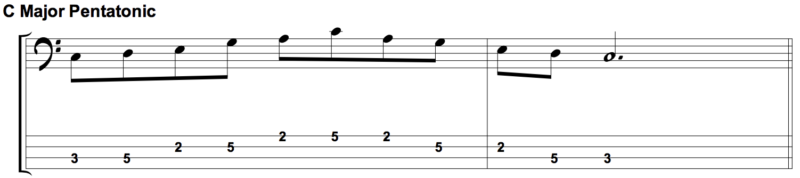
Scale Degrees 1 2 3 5 6 8 C D E G A C This is a five-note scale that is basically a stripped down version of the majorscale. The major pentatonic has twonotesmissing that makes it different from the major scale – the 4th and the 7th. These two are missed out as they need to be placed more carefully in a song, whereas the others work well in most situations. This scale works really well over chords I, IV and V and is a great scale to start with if you are beginning to learn how to solo and improvise.
3. The Natural Minor Scale
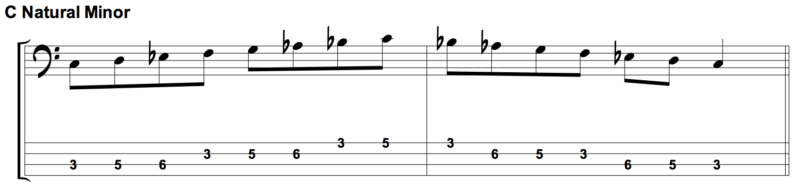
Scale Degrees 1 2 b3 4 5 b6 b7 8 C D Eb F G Ab Bb C The natural minor scale can be found by playing the majorscale starting from the 6th degree. For example, if we played the C majorscale from A (the 6th), then we would get the A natural minor scale. C D E F G A B C D E F G A 1 2 3 4 5 6 7 1 2 3 4 5 6 This scale provides the pallet of notes for songs in a minorkey.
4. The Minor Pentatonic Scale
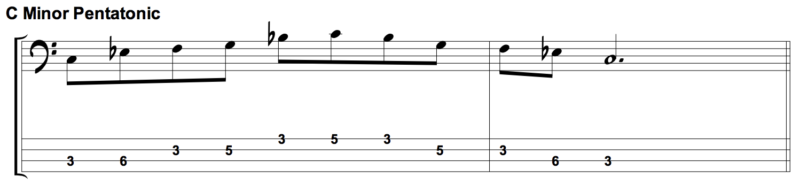
Scale Degrees 1 b3 4 5 b7 8 C Eb F G Bb C The minorpentatonicscale is another five-note scale that can be used by beginners to solo in a minor key without running the risk of hitting notes that might clash. This scale is made by taking the natural minor scale and missing out the 2nd and the 6th.
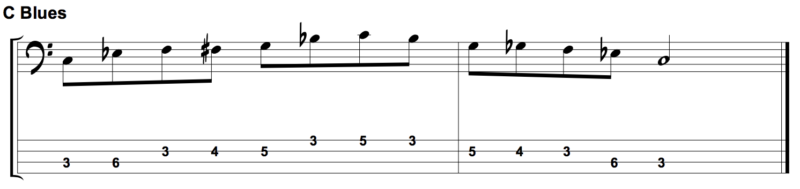
5. The Blues Scale
Scale Degrees 1 b3 4 #4/b5 5 b7 8 C Eb F F#/Gb G Bb C The blues scale is a popular variation of the minor pentatonic and contains just one extra note – an augmented4th (also called a diminished5th). This is a chromaticnote that leads into the 5th from the 4th and creates a nice bit of tensionandrelease. Even though it is out of key, the chromatic note works here as it is between two strong scale degrees and isn’t lingered on long enough to sound out of context.


Thanks again for great instructions. I’ve just recently completed my 1st part of Basic Fundamentals Course and decided to go back over again and again before moving on to 2. This helps in remembering the different scales from this video and to do something basic but a little different from my course. Thanks again I hope I can stay with it all the way till,I actually can play the bass.
Randy
Thank you Mark! I’m a bassist of nearly 30 years, but recently I have felt my playing was lacking a certain part of “me”. Your courses allow me to return to the fundamentals and discover myself again, as well as a host of styles I’ve not ever explored. Thanks so very much!!!!
Mark, you definitely are a master instructor and teacher (besides being an excellent bassist). I’m a former teacher and currently play the saxes for 60 plus years, and played some bass for a short time. But, I’m studying electric bass now along with still playing professionally. Bass is a deep passion of mine, and your lessons are clear, concise, and easily understood. Thank you so much. (Frustrated bass player).
Comment…you are so good
thanks for the lessons.. I enjoy that
This is a very good practice and I recommend this to everyone
Thanks. Am just a beginner, trying to teach myself
Awesome! loving playing along to your lessons, thank you
I loved how the scales patterns were explained. It’s “more complete and better organized” than what any paid teacher has taught me.
I knew all these anyway, as I’ve been playing for years. But man I wish I had this back when I started out.
You’ve done a great job here, will deffinatley recommend this to any new bassists I meet! Great work!
I have always enjoyed your unique style of teaching Bass guitar.
So awesome
This is helpful.
Thanks alot.
but chug
These lessons are so dense, I love them. Thanks for taking the time to share. I feel like other lessons only last as long as the video, but yours spawn hours and hours of follow up work, and present it in a way that’s a challenge we’re expected to meet.
Thank you!
Comment…i have learn a lot thanks
It was very nice and awesome
Thank you Mark for these lessons. They are great. I am learning a lot. I bought my first guitar at age 41 it hung in its stand for a year. than I was encouraged by my husband and friends to pick it up. Three years later. I still can’t play very well but I’m learning a lot by watching and playing with your videos.
Mark, thank you so much for your simple and easy to follow instruction video. I’m a drummer and always loved the bass but never went down that road.I’m 59 years old now and have nothing but time to learn the fundamentals of the bass.Your 5 easy bass scale for beginners video is exactly what I needed. This old dog can learn a new trick, thanks to your easy to follow videos.
Thanks mark you awseome