For the bass player who's always wanted to read music — and never had a clear path to get there.
9 levels. 25 hours of video. 700+ pages of material. The complete music reading system for electric bass — from your very first note on the stave to professional standard.
Simple Steps To Sight Reading is unlike anything else in the TalkingBass catalogue. It doesn't just teach you to read — it builds your fretboard knowledge, deepens your rhythmic understanding, and develops the kind of musical literacy that changes how you hear and play everything. Whether you're starting from scratch or you've been playing for decades, this is the method that works.
5.0 stars from 52 verified students on the TalkingBass store. Taught by Mark Smith to 451,000+ subscribers on YouTube.
$260
One-time payment · Lifetime access
30-Day Money-Back Guarantee · Instant Access
Most bass players are self-taught or learned by ear, and that got them a long way. But somewhere along the line, the inability to read music stopped being a quirk and started being a ceiling. You can't take certain gigs. You can't follow a chart. You pick up a bass book and it's basically hieroglyphics.
The frustrating thing is it's not a matter of talent or dedication. It's a matter of never having had a proper method — one that starts where you actually are, builds at a pace you can follow, and doesn't expect you to figure out the gaps yourself.
You've probably tried:

"I went to music college. And when I got there, I realised I was the only one who couldn't read. I had to teach myself — fast. That experience is the foundation of this course."
You look at the page. The notes make sense. The rhythm is clear. Your fingers find the positions without you having to stop and decode every bar. You're not working through the music — you're reading ahead, playing musically, actually enjoying it. That's not a pipe dream. It's a skill that's built the same way every other skill is built: step by step, with the right material in the right order.
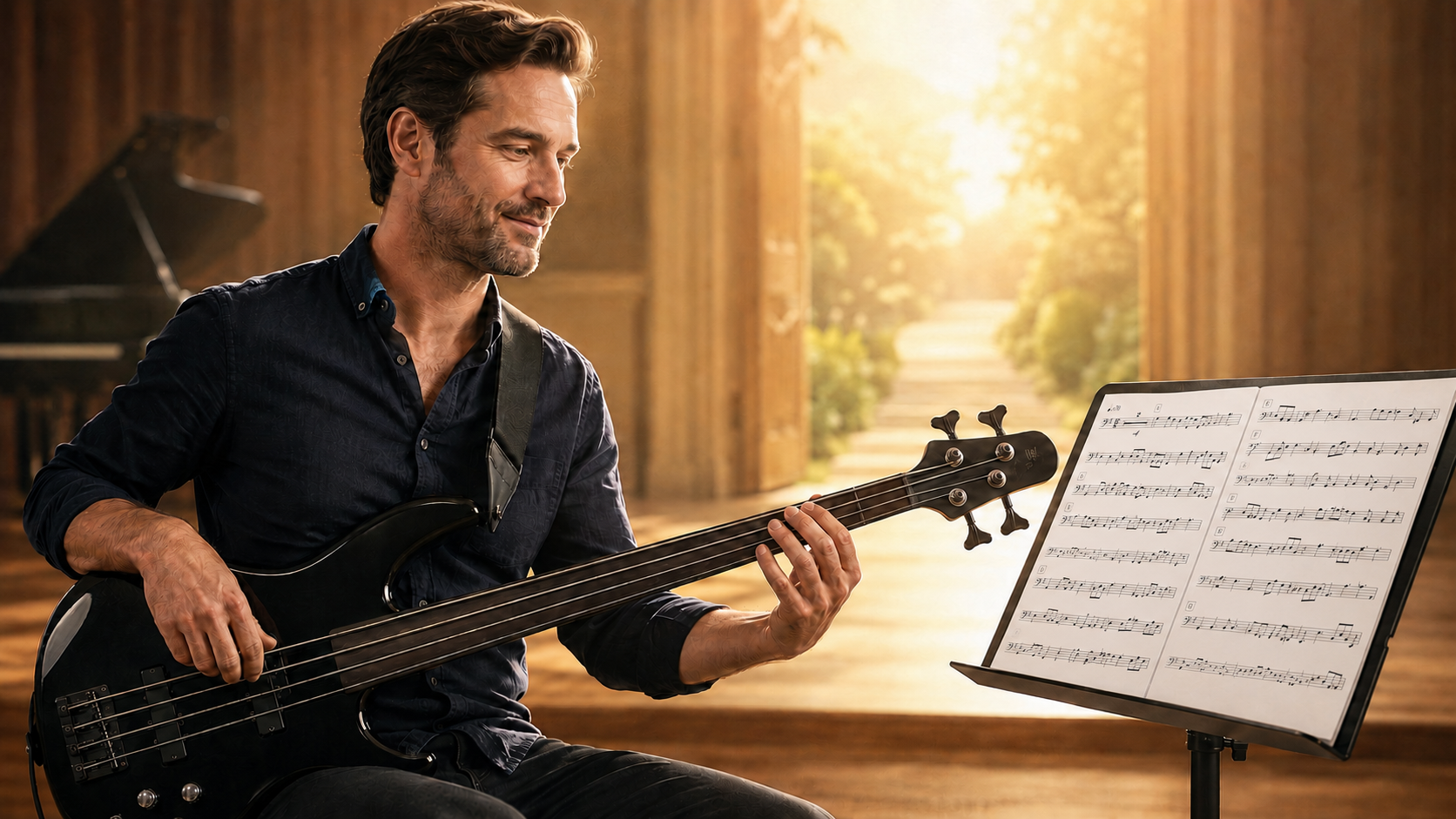
Sight reading forces you to keep your eyes on the page. As a result, every position on the neck becomes instinctive. Students consistently report that fretboard knowledge was one of the biggest unexpected gains from the course.
From whole notes to 16th note triplets in odd time signatures — every rhythmic concept is introduced clearly, explained in detail, and applied immediately to real reading exercises. You'll understand rhythm in a way that transforms your playing across the board.
Many professional and semi-professional gigs involve charts. Orchestra pit work, function bands with setlists, theatre, session work — all of it becomes available to you when you can read. The course takes you to the level where this is a realistic outcome.
Bass transcriptions, etudes, classical arrangements, jazz charts, big band parts — all of it is suddenly accessible. One student described it as going from "spelunking in the dark to walking in daylight." The literature available to a reading bassist is vast.
Nine levels. One next step. There's never a moment of wondering what to work on. You finish a lesson, you move to the next. The structure takes the guesswork out of development completely.
Learning to read isn't just a skill — it's a transformation. Students who finish even the first volume consistently describe a shift in how they feel about their playing. "I can now call myself a bassist," as one reviewer put it. That confidence is real and it compounds.
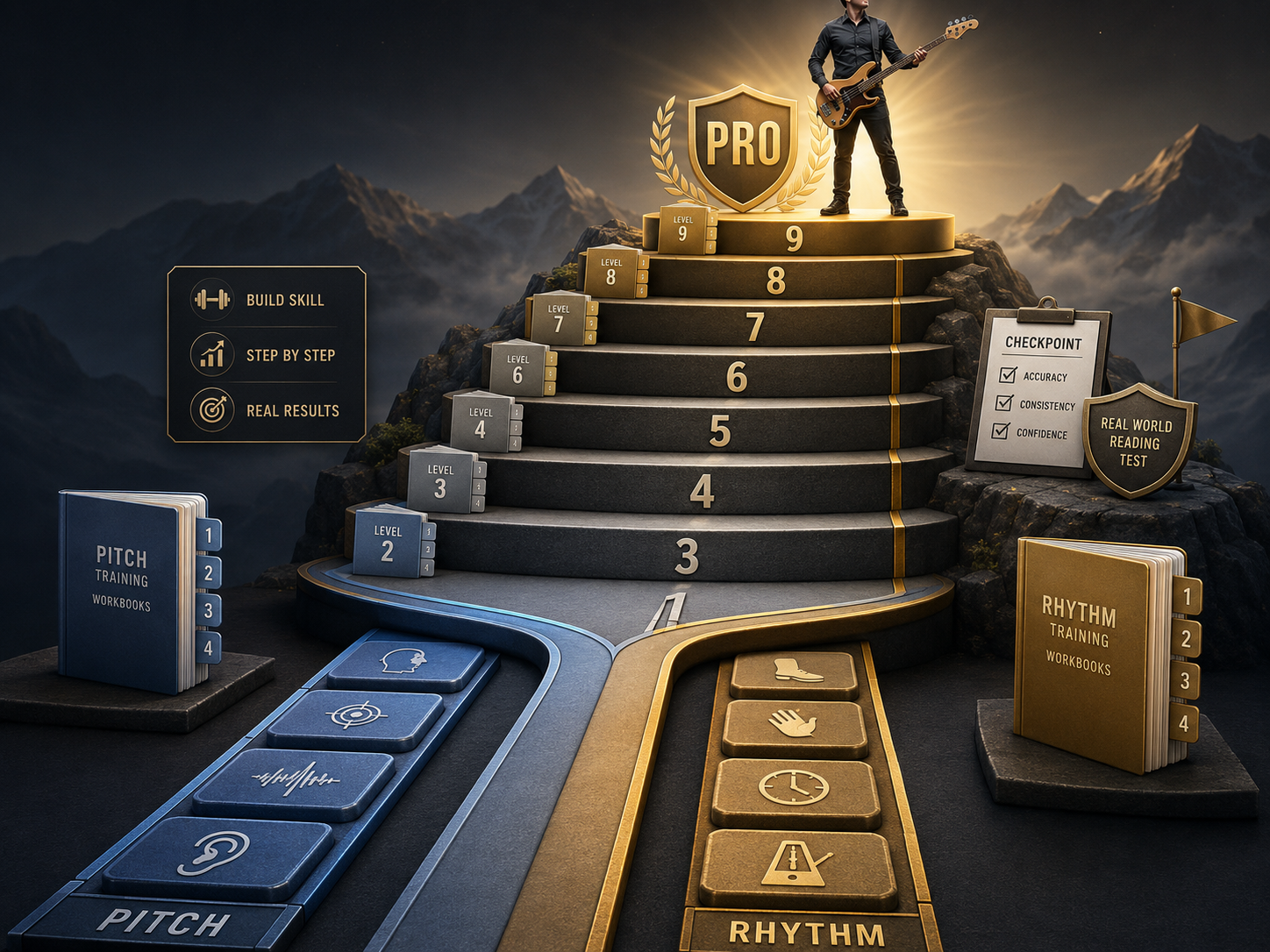
Pitch and rhythm are taught separately, then combined. One of the reasons self-study fails is that most people try to tackle reading as one big problem. This course breaks it into two distinct tracks — pitch reading (which notes are where on the fretboard) and rhythm reading (how long each note lasts) — before combining them in progressive exercises and etudes. Each skill is built on its own solid foundation before anything is added to it.
Every level has its own workbook — 700+ pages of practice material in total. This isn't a course about watching and absorbing. Every concept has dedicated written exercises, practice sheets, and etudes. The workbooks for each level are designed to be printed and used with a music stand — the same way a professional would approach a chart. You're not learning about reading. You're actually reading.
Sample pieces and etudes test your reading in real conditions. Each level ends with sample pieces — complete compositions that test everything covered in that level, played along to a backing track at sight. No practice run. Just reading. This is how reading ability is actually developed: regular testing in realistic conditions, not isolated exercises in a vacuum.
Nine levels means you never feel overwhelmed. The jump from beginner to professional standard is enormous — but you never feel it because each level is small enough to be entirely manageable. By the time you're reading 16th note triplets in odd time signatures at Level 9, you'll barely believe you started with whole notes on the E string. That progression is the entire point of the system.
No other electric bass course exists that covers this full range. From the absolute first note to professional sight reading standard, in one structured system. That gap in bass education is exactly why this course was built.
Introducing...
9 progressive levels. 25 hours of video. 700+ pages of material. The complete music reading method for electric bass — beginner to professional.

"I went to music college as a self-taught player and discovered, very quickly, that I was behind. I had to learn to read — fast — or I wasn't going to make it. So I taught myself using every resource available in the way I now teach everything: one small step at a time, in order, until it clicks.
This method of learning has provided me with a 25 year professional career in music as a sight reading sideman allowing me to travel the world and make a living doing the thing I love most. Music.
This course is that method, now refined over years of teaching it to students of all levels."
All three volumes are included in a single purchase. No separate buys, no Vol 1 → Vol 2 → Vol 3 decisions. Everything from your first note on the stave to advanced professional reading is in one place, available the moment you enrol.
30-Day Money-Back Guarantee · Instant Access
Level 1
Starts with the very basics of written notation — the stave, the bass clef, note names — and builds through pitch reading exercises on each string (E, A, D, G) in isolation and combination. Rhythm begins with whole notes and half notes, then adds rests and ties. Ends with 55 workbook exercises and four sample pieces to test everything at sight. By the end, you're reading real music in first position.
Level 2
Extends first-position reading to include all sharps and flats, string by string and in combination. Quarter notes are introduced — the rhythmic building block of most music — with dedicated practice sheets for notes, rests, and ties, plus speed reading exercises to develop the ability to look ahead. Ends with four sample pieces including original compositions written for the course.
Level 3
Introduces the concept of keys and key signatures — the circle of fifths, major tonality, G major and F major — allowing reading in different harmonic contexts for the first time. Dotted half notes and their rhythmic variations are covered thoroughly, along with 3/4 time, section markings, dynamic markings, and the D.S. al Coda. The four sample pieces include a waltz — a genuine milestone.
Level 4
Two new major keys (D major, B♭ major) followed by a thorough exploration of relative minor keys — minor scales, minor key signatures, and focused practice on double sharps and flats. 8th notes are introduced with their permutations, rests, and ties, plus time signature changes between 4/4, 3/4, and 2/4. Technique symbols (slurs, staccato) and navigation markings (D.C. al Coda, al Fine) complete the level.
Level 5
Moves beyond first position for the first time — second position is introduced with dedicated pitch reading exercises and guidance on planning shifts. Rhythmically, this level covers dotted quarter notes, more complex rest patterns, triplets, and swing feel. Grace notes, anacrusis (pickup bars), simile markings, and alternative notation complete the picture. A significant step up in both fretboard range and rhythmic complexity.
Level 6
Extends to four sharps and flats, with second-position work now covering G major and F major as well. 8th note ties are introduced in detail — multiple variations, dotted quarters, bar-centre ties — followed by triplet rests and ties, swing rests and ties. Compound time signatures (6/8 and 12/8) are covered fully. Technique notation for ghost notes, vibrato, and slides round out the level.
Level 7
Five sharps and flats in both low and mid positions, with key changes within pieces. 16th notes are introduced — the rhythmic foundation of funk, soul, and contemporary bass playing — along with quarter note triplets, compound time rests and ties, and cut common time (2/2). Tempo markings, accent notation, and specialist technique markings for slapping, popping, and tapping are all covered. Eight original etudes complete the level.
Level 8
Six sharps and flats, with the introduction of the high position above the 12th fret. 16th note rests in extensive detail, followed by 16th notes in compound time, shuffle 16th notes, and ties in cut common time. Odd time signatures — 5/4 and 7/4 — are introduced here. Fermata, rallentando, ritenuto, and string bend notation complete the theoretical vocabulary. Eight original etudes for this level.
Level 9
All remaining key signatures (seven sharps/flats, C# and C♭ major), with the high position levelled up across every key — completing total fretboard coverage. 16th note ties in every context, compound 16th ties, shuffle ties, odd time 8th note meters (5/8, 7/8). Advanced rhythmic concepts including 16th note triplets, duplets, and half note triplets. Trills, tremolo, harmonic notation, and chordal notation. After Level 9, there is nothing left to cover.
30-Day Money-Back Guarantee · Instant Access

Every level comes with a complete PDF workbook — pitch reading exercises, rhythm practice sheets, combined etudes, and sample pieces. These are professionally typeset materials designed to be printed and used at a music stand. This is a real method book, not a set of screenshots. Students consistently say the workbooks are worth the price of the course on their own — and many are still using them years after completing the videos.
Every sample piece and etude comes with a full backing track — real instruments, recorded specifically for the course. You're not playing to a metronome. You're reading along to actual music. This makes the experience of reaching each level's sample pieces genuinely exciting — and teaches you what it actually feels like to read with a band behind you.
Everything streams on members.talkingbass.net — any device, any time. The platform tracks which lessons you've completed, picks up exactly where you left off, and shows you where you are across all nine levels at a glance. The difference between students who finish a course and students who abandon it is almost always structure. The tracking builds that structure automatically.
30-Day Money-Back Guarantee · Instant Access
★★★★★ 5.0 stars · 52 verified reviews
"This course is a real game changer. I can't over-estimate how much it is doing for my playing skills. It's really like learning to read: I knew how to spell letter by letter but I couldn't read words, or sentences, because I was busy remembering the shape of each letter. Mark's approach, of small incremental steps, is really working for me. After a while you find out that you have improved when you are able to do things that just a few days before seemed hard. Why haven't you taken this course yet, what are you waiting for?"
"I'm only 2/3 of the way through this course and I can already read and play a sheet of music. I can't play several pieces at tempo yet, but can easily figure out a piece, and only occasionally need to look at my hands while I play. Amazing. There is a lot of practice material and his instruction is great — very comprehensive, methodical. My only regret is not investing sooner."
"I have been playing bass since I was 12 — I am 63 now. Not only am I learning to read music but also the finger positions for my new fretless as a consequence. I highly recommend this course — great value and awesome learning resource."
"I decided to start from the beginning and work through the whole course, even though I had previous sight reading experience. Every lesson — even 'easy' ones — had some useful bass-specific tip I didn't previously know. The practice sheet for each lesson is invaluable. I can't recommend this course highly enough."
"I went from being completely music illiterate to being able to read music and having the first 6 frets totally memorised in about a month. I can now pick up a piece of written music for bass and figure out how to play it without tabs. I'm so impressed I've purchased many of Mark's other courses."
"For years I'd been limping along with handpicked bass lessons online. Finally I bought Simple Steps to Sight Reading and it was a game changer. At Mark's suggestion I'm not rushing through it or moving on unless I have really nailed each lesson. My husband can't believe how it's changed my ability to jam with him."
"This course is by far the best investment I have ever made in my bass education. The way Mark breaks down everything into bite-sized pieces is what makes his courses stand alone. My only regret is not investing in them sooner."
"The advice elsewhere is that the ability to read isn't necessary for the typical bassist, and tab is easy to grasp, so don't bother. Now that I've finished Volume 1 and started Volume 2, here's my advice: the sight reading series is the most important course here, bar none. Reading bass clef will free you from tab — and that is an amazing confidence booster."
"I've been working on this course for about 1.5 years and the progress has surpassed my expectations. I'm now able to play easier big band charts on the fly and work out harder ones with practice. Unlike many other methods, this course acknowledges that it takes a lot of practice and provides tons of worksheets — about one medium folder per volume. It's so rewarding when you don't have to hassle with tabs any more but can just play a bass line right off the page at first sight."

Try it. If it's not for you, you get every penny back.
Take a full 30 days to work through the lessons. If the course isn't giving you something real to work on — if you're not making tangible progress through the levels — just email and you'll get a full refund. No questions, no forms to fill in, no friction.
This isn't the fast track. There isn't one. But this is the most direct, most thoroughly structured path to becoming a reading bassist that exists for the electric bass — and it's been proven on students at every level, from absolute beginners to players with thirty years under their belt.
30-Day Money-Back Guarantee · Instant Access
Honest answers, no spin.
30-Day Money-Back Guarantee · Instant Access

I'm a bassist and teacher from Yorkshire, England. I've been teaching bass online at TalkingBass since 2013. The channel is at 451,000 subscribers now, and the most common question I get — across 13 years of teaching — is some version of: "Should I learn to read music? And if so, how?"
My answer is always yes. Reading changed everything for me as a player. I went to music college as a self-taught bassist and discovered very quickly that I was behind. I couldn't read. I taught myself — fast — using the same step-by-step method that became this course. It took three years to build properly. 700+ pages of original exercises and etudes, 25 hours of video, nine complete levels. I'm prouder of this course than anything else in the catalogue.
The electric bass has been neglected in music education. Proper reading methods for bass are rare. I wanted to change that — to give every bass player access to the kind of systematic, progressive instruction that simply didn't exist online for our instrument. Simple Steps To Sight Reading is that course.
Simple Steps To Sight Reading includes:
One-time payment · Lifetime access
30-Day Money-Back Guarantee · Instant Access
That's Simple Steps To Sight Reading. Nine levels, 25 hours of video, 700+ pages of material — the only complete music reading method for electric bass, built to take you from your very first note on the stave to professional reading standard. If that's the gap you've been meaning to close, the link's right there.
