For the intermediate bass player who's still stuck in the one-octave box.
Chord Tone Essentials is the 53-lesson course that walks you through every chord you're ever going to meet, shows you where each one sits on the neck, and gets you building real bass lines from the notes inside them. Built for players who've already got the basics under their belt. Step-by-step, bite-sized chunks, no hype, no shortcuts. Just the clearest path I know to playing the bass properly.
5.0 stars from 45 verified students on the TalkingBass store. Taught by Mark Smith to 451,000+ subscribers on YouTube.
$130
One-time payment · Lifetime access
30-Day Money-Back Guarantee · Instant Access
You can play. That's not the question. The question is what actually comes out when nobody hands you a chord chart. Someone calls a 1-4-5. The drummer locks in. The guitarist comps. Everyone looks at you. And you play the root. Maybe an octave. Maybe the fifth. It sounds fine. Safe. And you know it. You're following the chords. You're not really playing them.
You've probably tried:
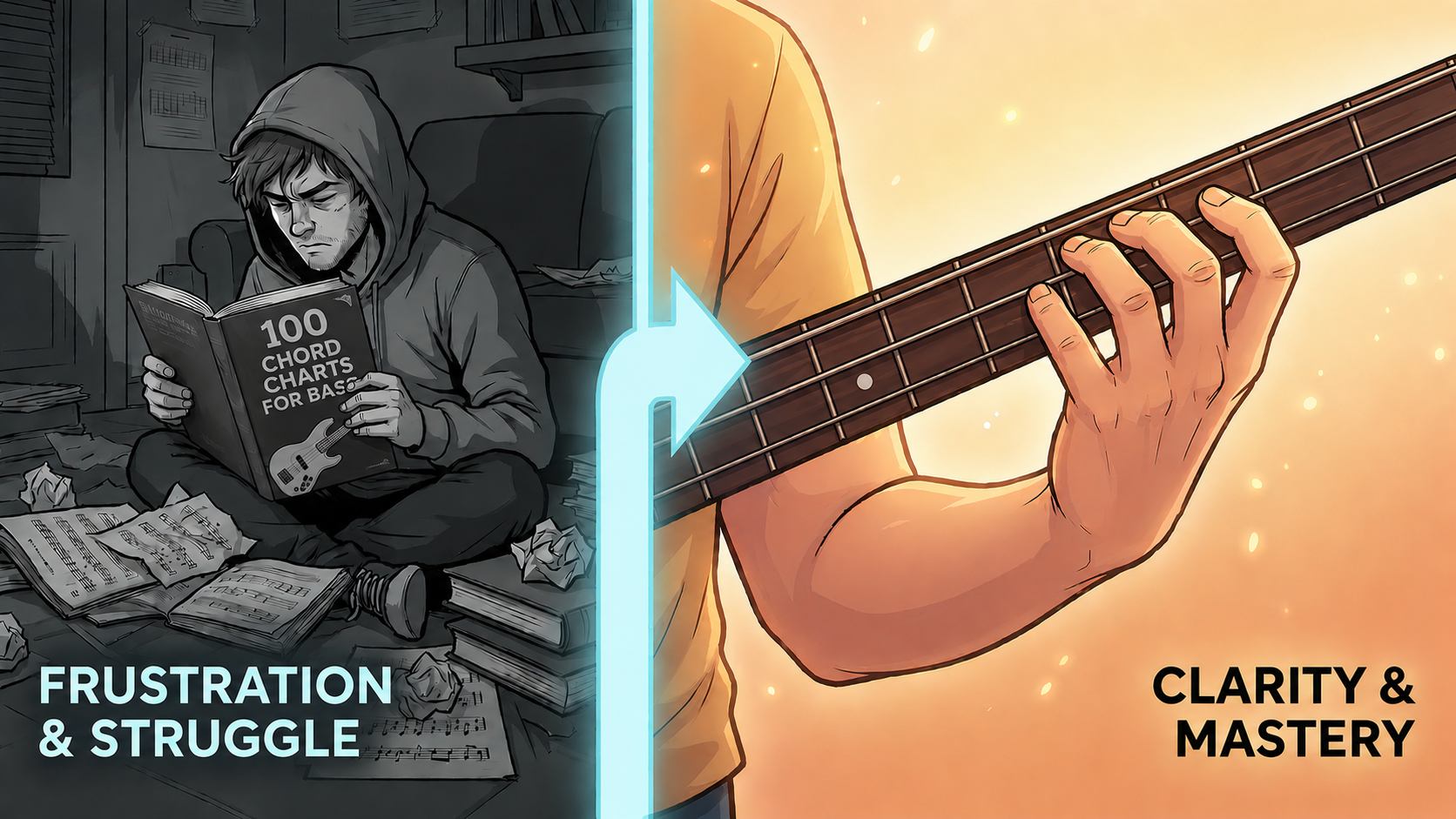
It's not your ear. It's not your age. It's not the years you've put in. It's that nobody's actually shown you how the chord, the fretboard, and your fingers join up. That's it.
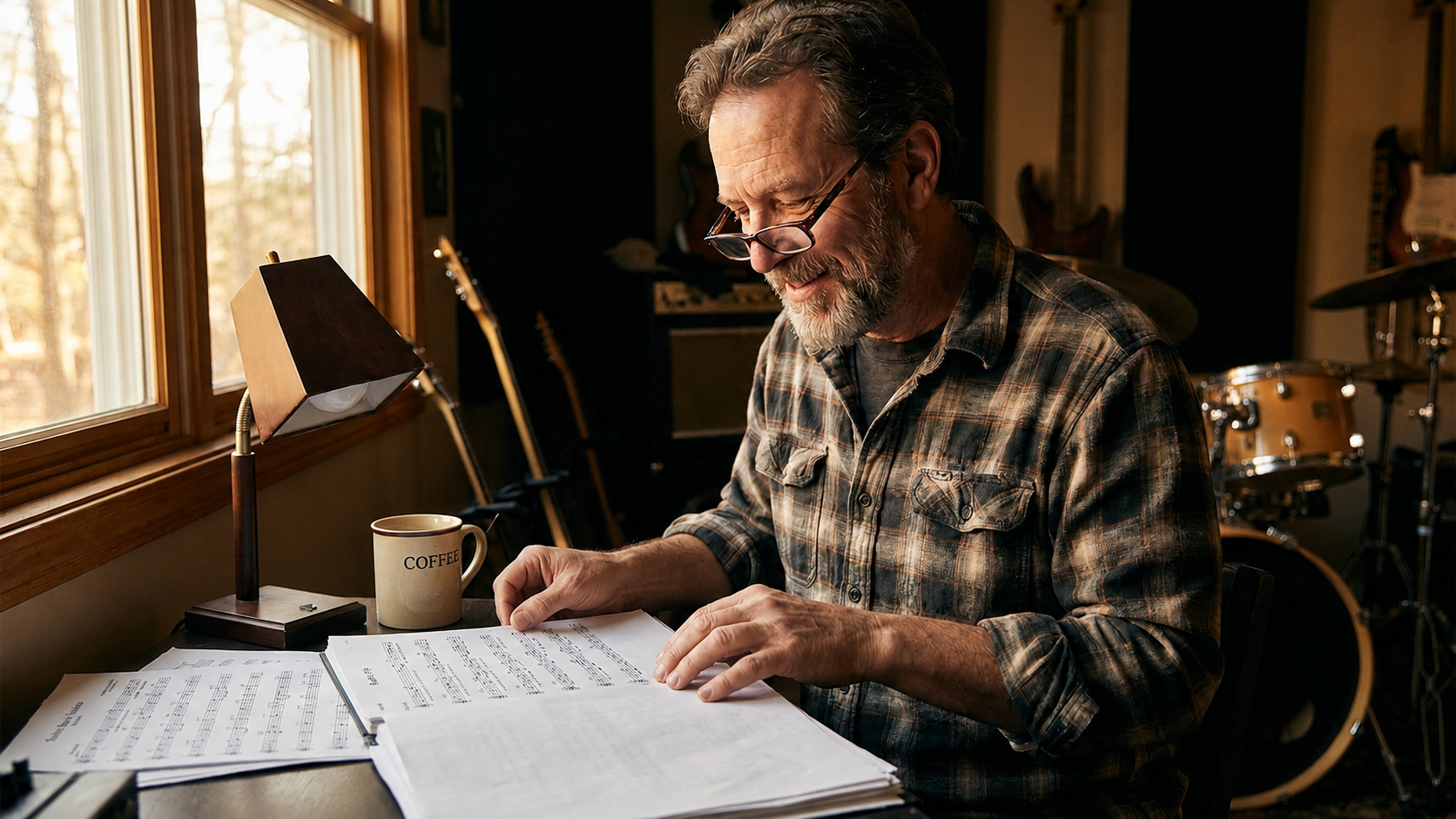
So, picture this. Someone calls C6 to Am9 to Dm11 to G13b9. And you don't freeze. You hear the chord, you see the notes on the fretboard, your hand goes where it needs to go. Not because you've memorised that particular progression. Because you finally understand what's underneath every progression. That's the lightbulb moment. That's what this course is really for.
You'll know the notes inside every chord the band is playing, on every string, in every position. That's the bass player's actual job. It's the difference between someone who survives the song and someone who's part of it.
Right now your fills kind of happen by accident, and half the time they don't even fit the chord underneath. After this, your fills are built straight out of the chord tones that are actually playing under them. They land. Other musicians look up.
You keep your pentatonic fluency. You just stop leaning on it because it's the only door you know how to open. The whole fingerboard becomes available. Not just the first four frets you've been camping in for years.
You'll have three different fretboard patterns for every arpeggio, so you can stay in one area through a whole progression instead of jumping all over the neck. Cycle of fourths. Cycle of fifths. Wherever your hand happens to be sitting.
You'll hear a bass line on a record and you can name the chord, point to the notes, and play it back. That's confidence that doesn't go away when the YouTube tab disappears.
Creativity isn't a personality trait you were born without. It's really just downstream of knowing what's actually under your fingers. Once the chord tones are there, the lines you wished you could write start showing up on their own.
None of this is about more practice or more talent. It's about one shift most bass methods skip. And it's the shift I build every module of this course around.
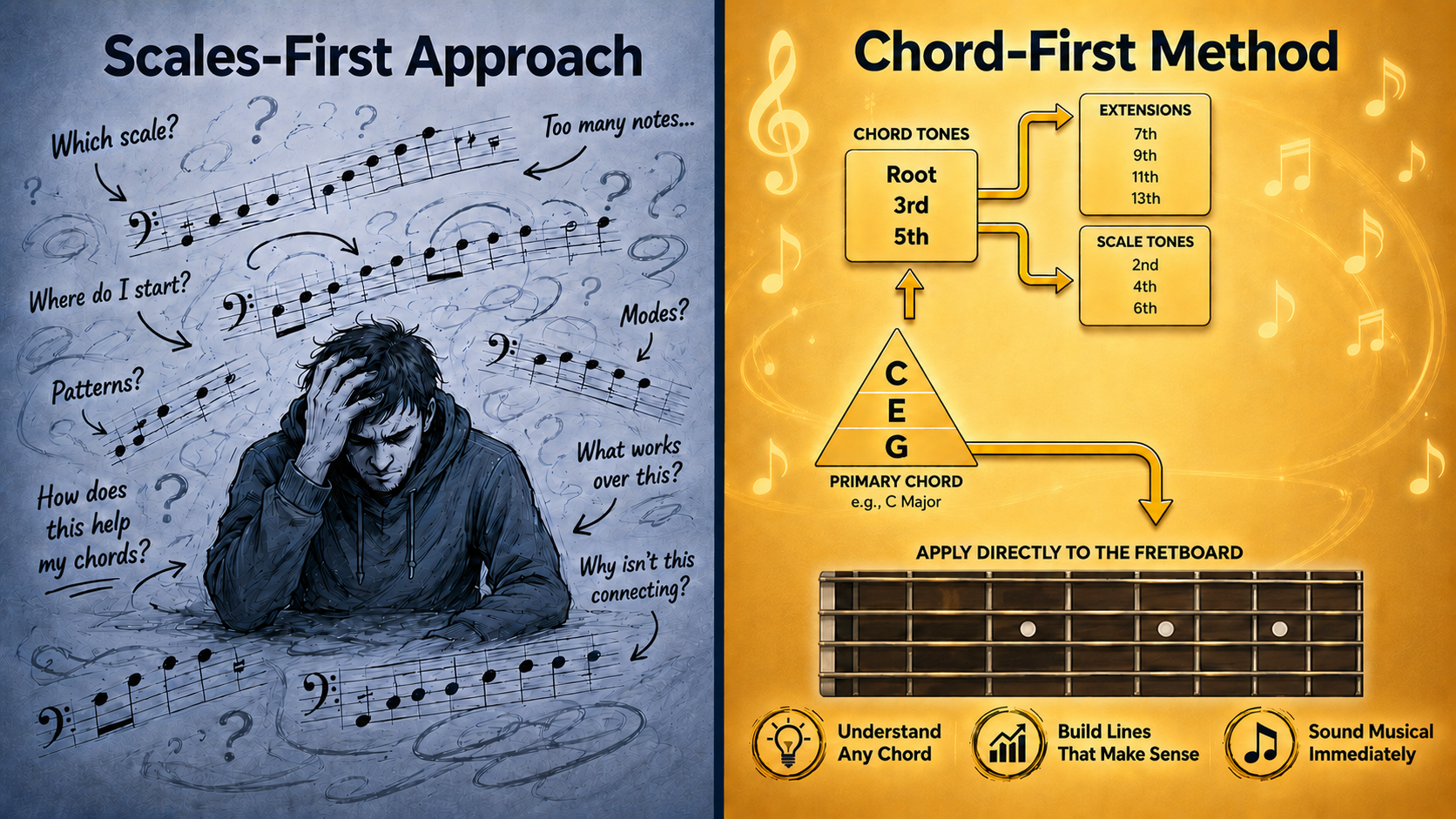
So, almost every bass course starts the same way. Major scale. Minor scale. Pentatonic boxes. Then, somewhere around module seven, "okay, now let's talk about chord tones." And so you've learned to run before you've worked out what you're running over. That's why your solos sound like scale exercises, and your fills sound like pentatonic licks pasted on top of whatever chord happens to be playing. The notes aren't wrong, exactly. They're just sitting on top of harmony you haven't really seen yet.
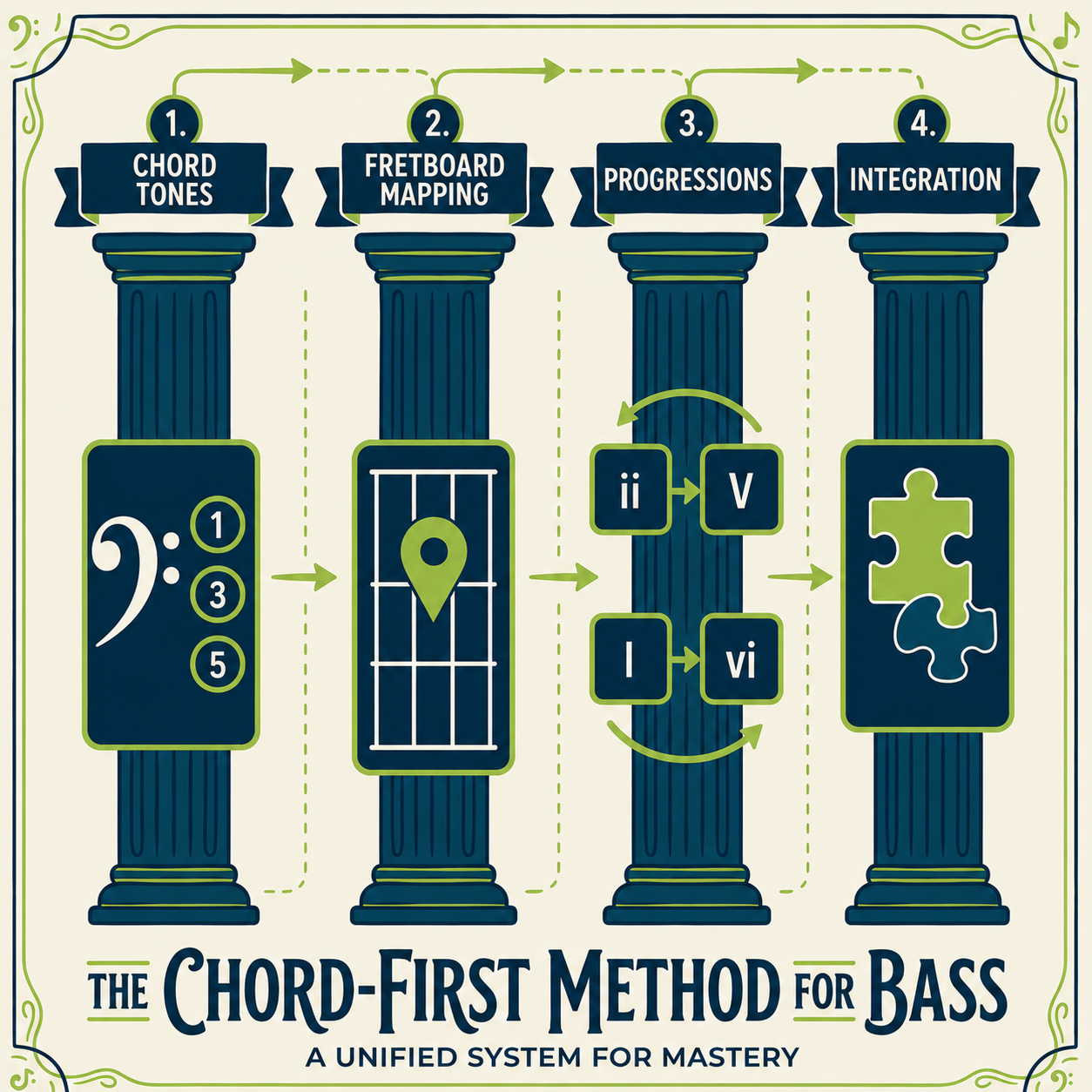
That's the framework.
Chord tones are the framework that all tonal music is built from. They're the notes of the chords you're playing over, so they blend and they play nice. Anything else — passing notes, neighbour notes, scales, chromatic stuff — is just ornamentation around them. Once you can see those chord tones across the neck, you've got bearings. Everything else makes sense from there.
Inside that, I teach multiple fingerings for every arpeggio based on three simple fretboard patterns. With those three patterns under your hand, you can play I-VI-II-V in F major — Fmaj7 to Dm7 to Gm7 to C7 — without the hand ever really moving. The scales become a kind of skeleton joining those chord tones up, dot-to-dot. And once you can see that, every other concept anchors onto something solid. Start simple in a single area. Then expand out over the entire fretboard.
I've been teaching bass online for over a decade. The channel sits at 451,000 subscribers now. The course has 45 five-star reviews on the existing store page. I built this thing because it's the way I had to teach it to myself in the first place. There was a single afternoon in music college — dark winter outside, sat at my desk with a notebook — when this clicked for me. Everything going forward got easier from there. And honestly, every course I've made since has been an attempt to give somebody else that same lightbulb moment.
So, the course I built around it is pretty much the course I wish I'd had myself.
Introducing...
The complete chord-tone course for intermediate bass players who are tired of guessing.
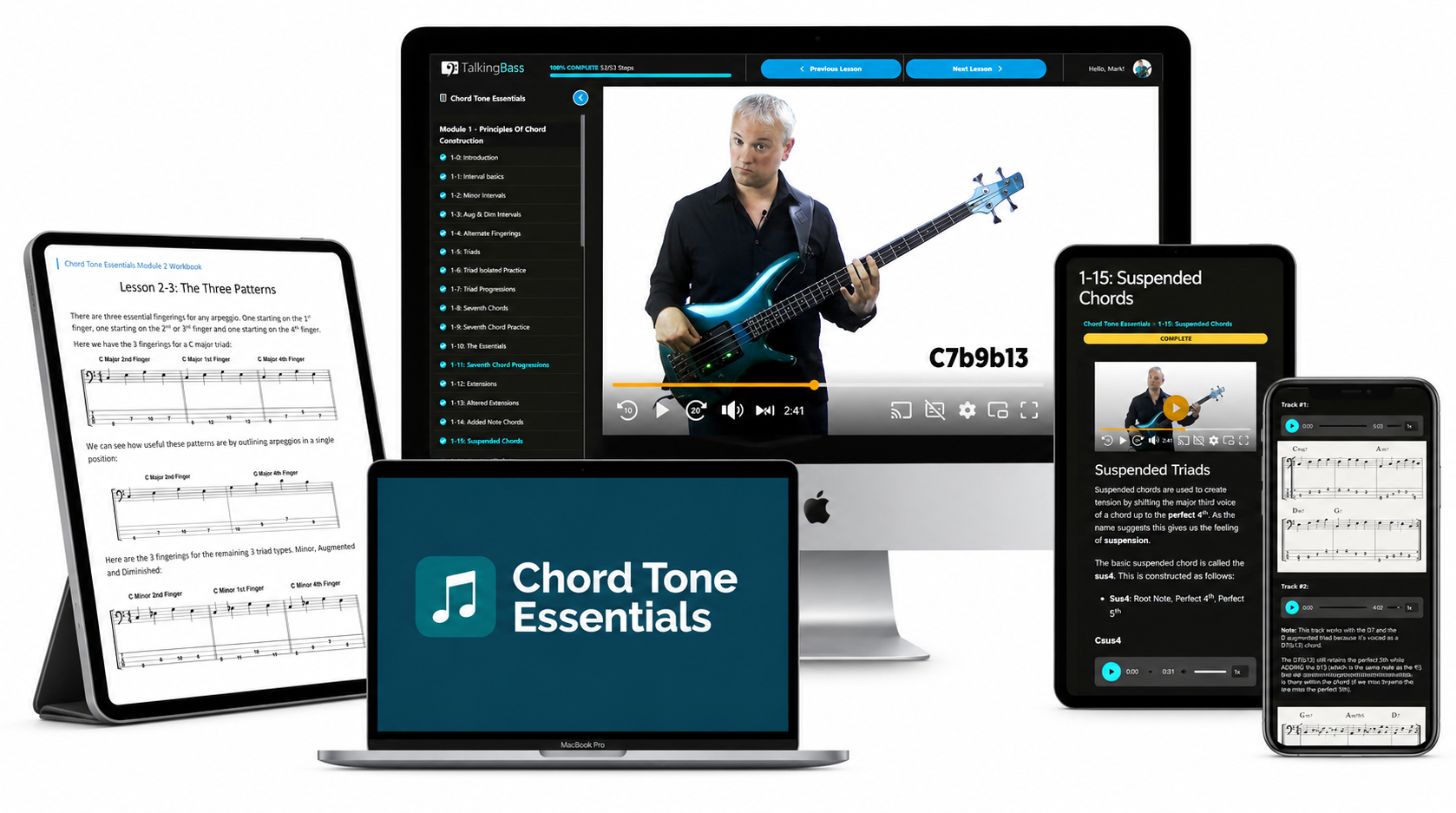
I built Chord Tone Essentials for intermediate players who've already got the basics, but freeze when it's time to actually create something. In 53 step-by-step lessons, you'll learn how every chord is built, where to find the arpeggios of each chord on the fretboard, and how to turn the notes inside it into real bass lines. The whole course is built up in simple steps, bite-sized chunks, one thing on top of the next.
So, every lesson is bite-sized. You can sit down for fifteen or twenty minutes after work and walk away with something you can actually use. The course lives on members.talkingbass.net, streams on any device, and you've got it for as long as the site does. Which, for what it's worth, has been over a decade and counting.
30-Day Money-Back Guarantee · Instant Access
Module 1 — 18 Lessons
So, this is where it all starts. We run through the chord construction principles for pretty much every chord you're ever going to meet. We start with intervals — the building blocks of music — then triads, then move up through all seven seventh chords. After that we get into the extensions — 9ths, 11ths, 13ths — then suspended chords, inversions, and slash chords. Don't worry too much about the terminology for now. Every concept gets shown on the fretboard, played out loud, and tied to a chord you'd actually see in real music. By the end of Module 1, you can read any chord symbol on any chart and know exactly which notes belong inside it.
Module 2 — 16 Lessons
This is where the three-pattern system lives. You'll learn three finger patterns for every arpeggio extended across all strings so you can cover the whole fingerboard from open string to highest fret with an easy-to-learn sequence of hand positions. We work it through the cycle of fourths before applying position shifts and arpeggio sequences to the framework. So the chord tones aren't just shapes you're memorising. They're notes you actually know.
Module 3 — 18 Lessons
Now we put the chord tones to work in real music. You'll learn how to apply the chord tones over a progression, then we add passing notes, neighbour notes, approach notes, and enclosures. We cover bass lines in a variety of styles from soul to rock to reggae before adding walking bass, fills, and soloing. So your lines stop sounding like exercises and start sounding like the records you grew up listening to. That's pretty much the point of the whole thing.
30-Day Money-Back Guarantee · Instant Access

The hardest part of any course like this isn't the watching. It's coming back to it next week and remembering where you got to. So the workbook is your written companion to all 53 lessons — chord-tone diagrams, fretboard maps, written exercises, and notation for every example I play on screen. Three separate PDFs, 124 pages in total, fully laid out so you can keep one beside your bass and practise without rewinding video.
You'll get the full set of practice audio and chord-progression backing tracks I use throughout the course. Every chord tone exercise, every progression, every walking line has matching audio you can loop, slow down, or play along to. So when I ask you to play through Fmaj7, Dm7, Gm7, C7 with three different fingerings, you've got a real track to play over. Not just a metronome clicking at you.

Most online courses are really just a folder of videos with no idea where you left off. The members site tracks every lesson you've completed, marks where you are in each module, and lets you pick back up exactly where you stopped. It sounds like a small thing. It's actually the difference between finishing the course and abandoning it three weeks in.
30-Day Money-Back Guarantee · Instant Access
45 verified student reviews — 5.0 stars
"This course eliminates just noodling on Pentatonics! It's an essential intermediate-level foundation that every bass player needs."

"Despite 40 years of playing guitar, this course has been an eye opener for me. I'm seeing the fretboard in a completely different way."

"There's literally years of material here for you to work on. I keep coming back to it and finding new things every time."

"Mark will guide you through the steps to becoming the player you want to be. The structure is what makes the difference."

"This is a great way to learn harmony and its application to the instrument. Mark connects the chord knowledge to what you're actually doing with your hands."

"There are so many 'Ah-Ha!' moments within this course. If you are wondering how some players just know what the right notes are while improvising a solo or bass line, this is the BEST place to start."
"Definitely a game changer. If you want to understand the basics behind bassline construction and apply these concepts to real life situations, this course is for you."
"You will be able to reference this course for years."
"Prior to this course I was mostly a memorizer of other musician's bass lines. Now I am understanding how they create these bass lines and I am on track to create my own. I agree with others that have taken this course, there is a lifetime of practice material in this course... this course is well worth the money!!!!"
"I picked up and put down instruments my whole life. This is my 3rd attempt at playing bass. I always started with Scales and learning to read music but I never understood why learning scales is important. This course has really set me on a path of understanding how/why music works... There are so many 'Ah-Ha!' moments within this course... This is not the fast track but in my opinion, it is the right track. 5/5 and then some."

Just try it. If it's not for you, you get every penny back.
So, take a full 30 days to work through the lessons, do the spelling drills, and play the patterns over the backing tracks. If you don't feel the fretboard starting to make a little bit more sense — if you don't see your own playing shifting from following the chords to outlining them — just email me and you'll get a full refund. No questions, no forms to fill in, no friction.
Look, this isn't the fast track. But in my view, it is the right track. Take it as slow as you need to. Over time, you'll have it under your fingers — and once you do, you'll wonder how you ever played without it.
30-Day Money-Back Guarantee · Instant Access
Honest answers, no spin.
30-Day Money-Back Guarantee · Instant Access
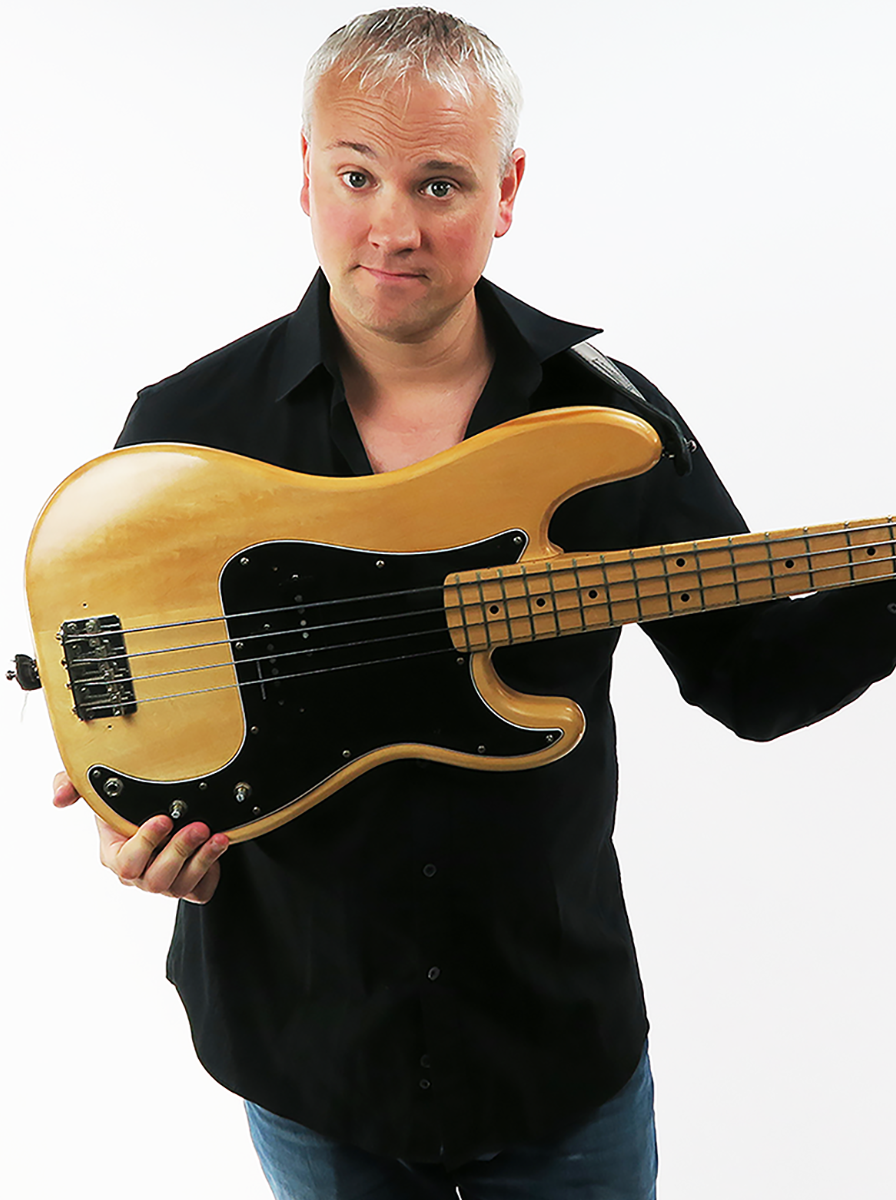
So, I'm a bassist and a teacher from Yorkshire, England. I've been teaching bass online at TalkingBass since 2013. The channel sits at 451,000 subscribers now, with a few thousand emails a year from players asking pretty much the same question in different words: why doesn't this make sense yet?
I just want to make complicated things easy — that's pretty much the whole job. I built Chord Tone Essentials because it's the course I wish somebody had handed me when I was stuck in the one-octave box myself.
When I stumbled onto this way of looking at the fretboard, it was a huge lightbulb moment for me. And honestly, the whole point of this course is to pass that on. No hype, no shortcuts. Just the clearest path I know to playing the bass properly, step by step.
Everything below is included in a single one-time payment. No subscriptions, no recurring fees — just lifetime access to the full course and everything that comes with it.
Chord Tone Essentials includes:
One-time payment · Lifetime access
30-Day Money-Back Guarantee · Instant Access
So, that's Chord Tone Essentials. 53 lessons, broken into bite-sized chunks, built up from the absolute basics. If it sounds like what you've been looking for, the link's just below. Trust me — once the framework's there, everything else makes sense from it.
